LinearB Alternatives (2026): The Honest Shortlist
THE HONEST SHORTLIST
Six real LinearB alternatives compared for mid-2026 - Swarmia, Jellyfish, DX, Faros, GitClear, Busfactor - with honest trade-offs and cited pricing.
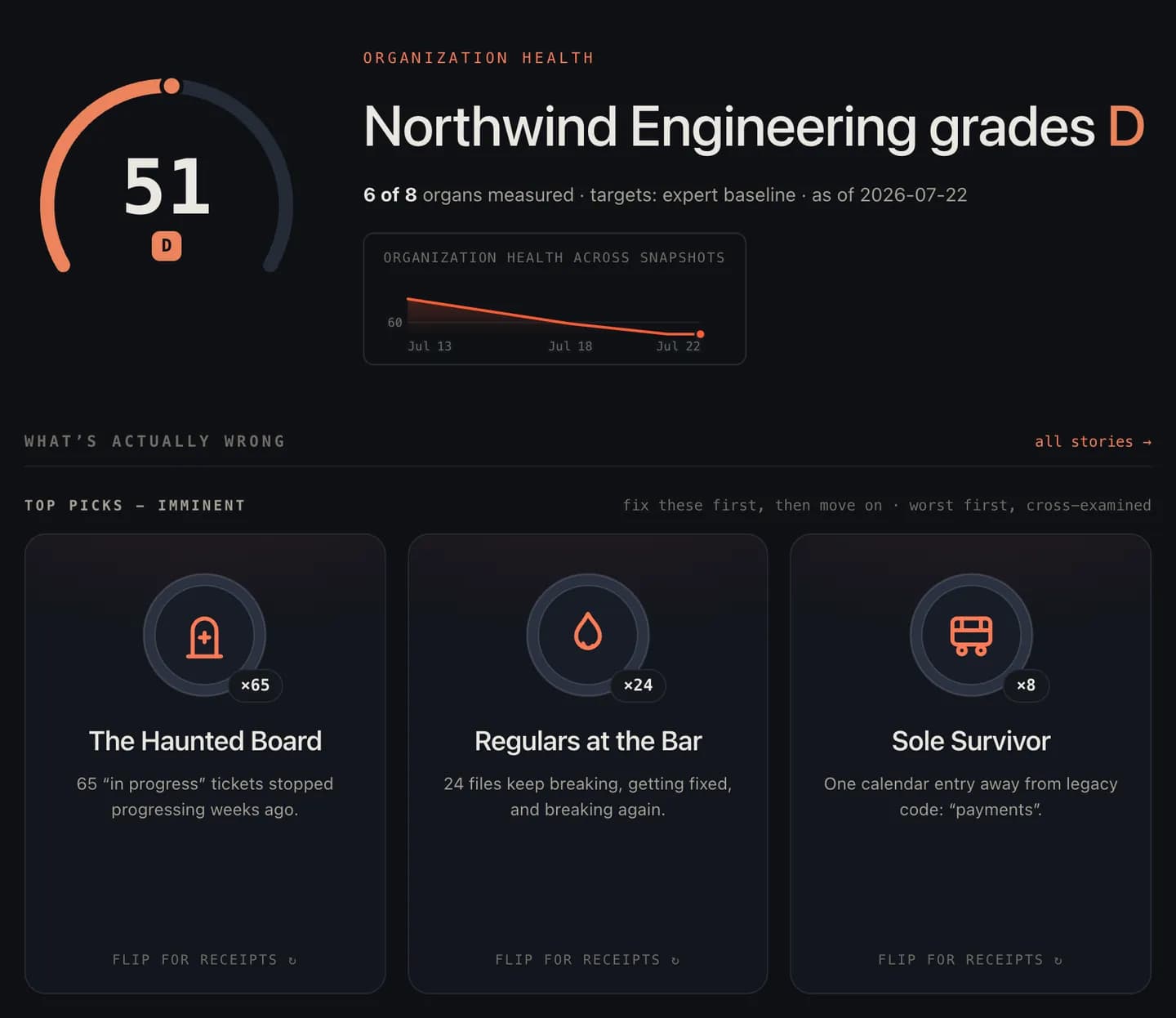
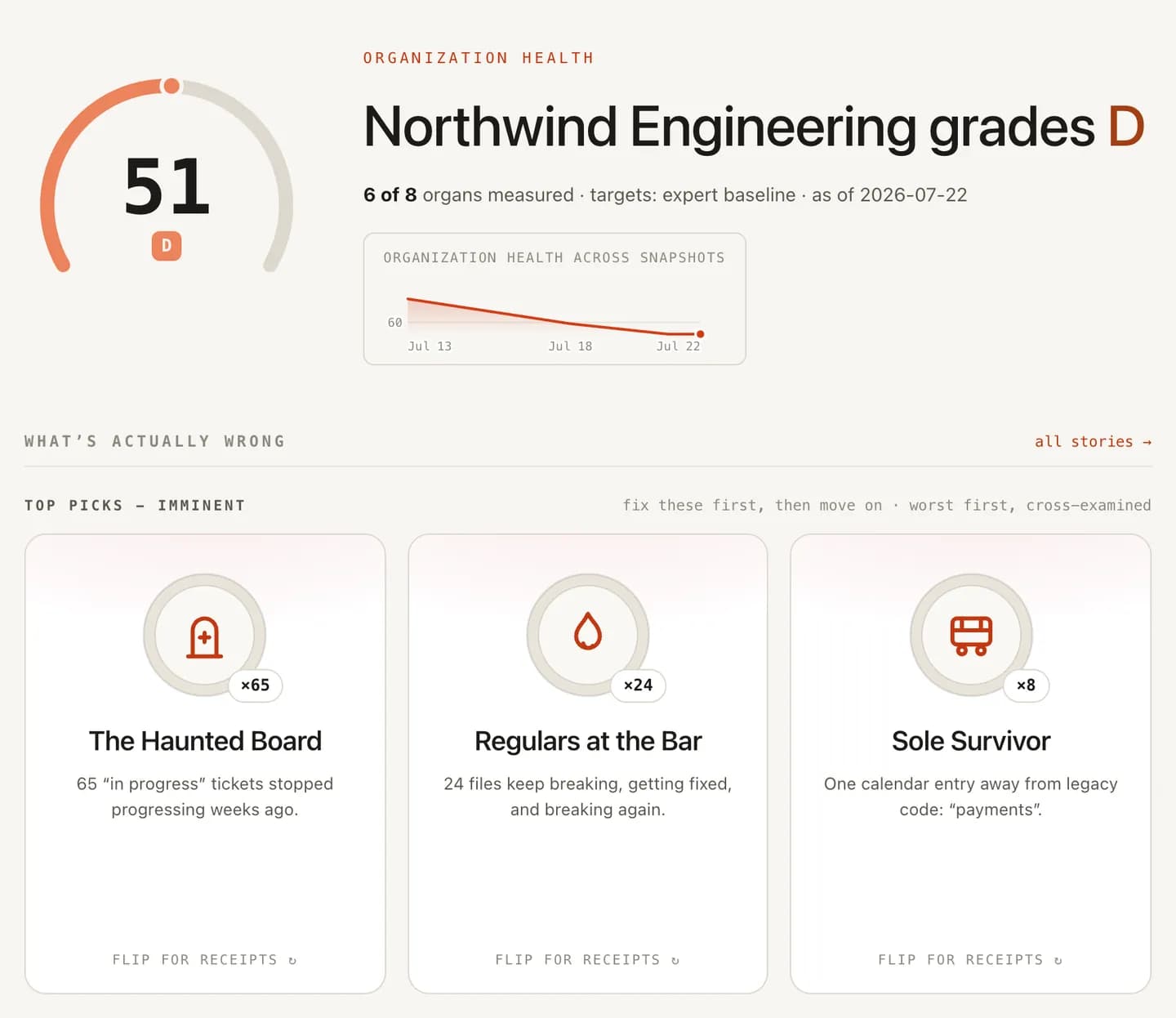
Organization health - 5 of 8 organs measured
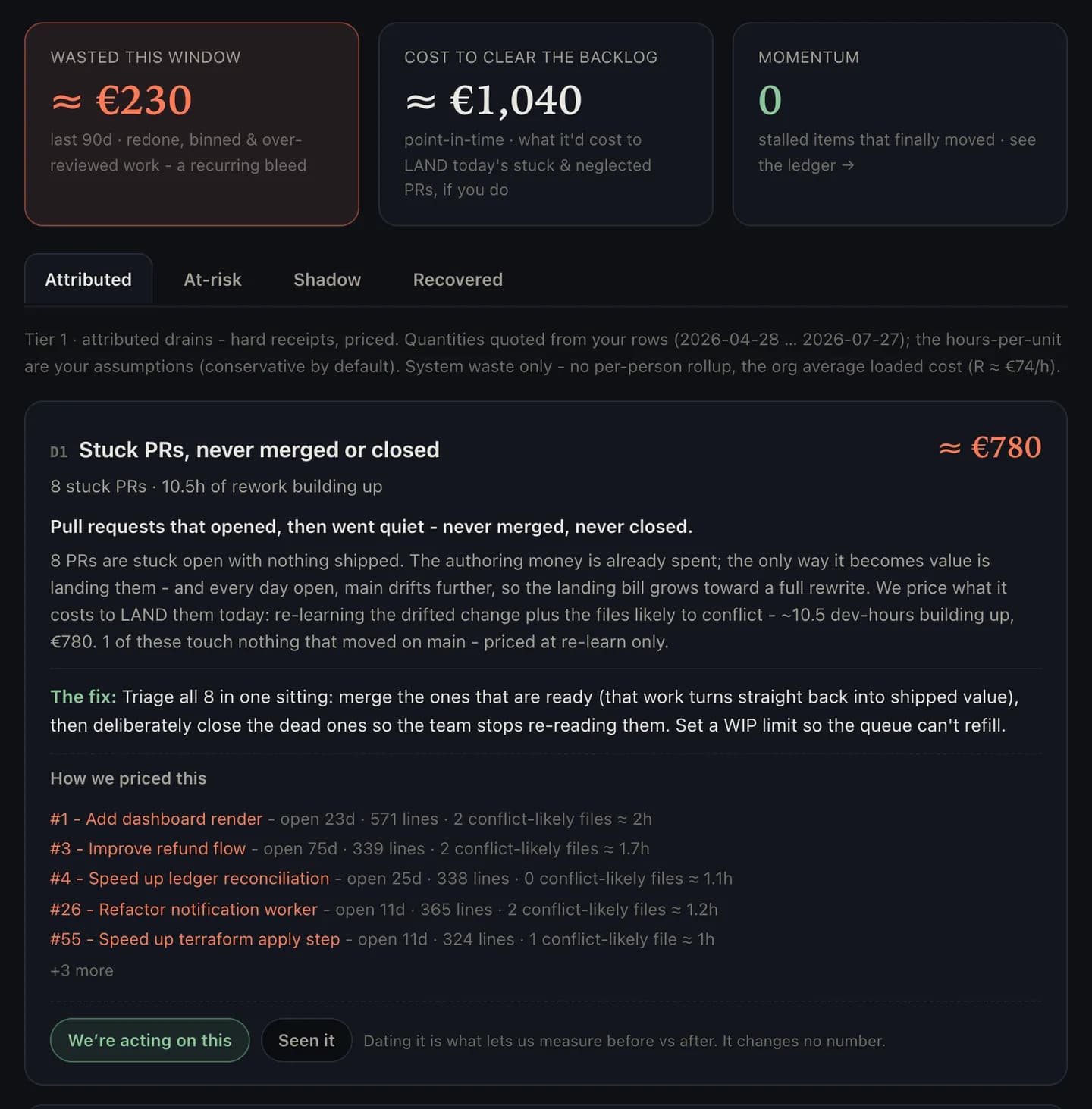
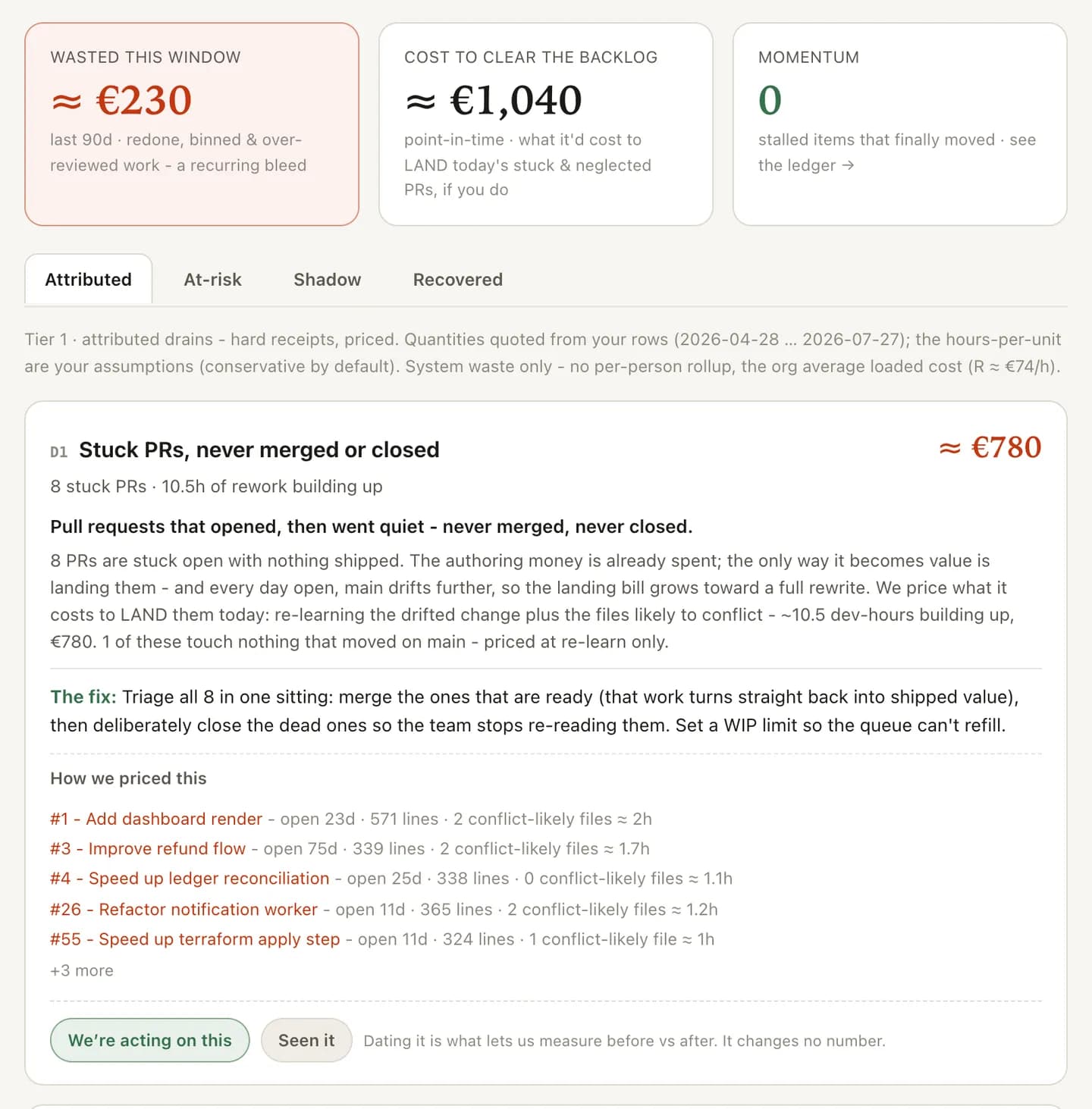
Illustrative example
TL;DR: LinearB earned its position (Gartner Leader, the category's largest published benchmark cohort, real PR automation), and if those are your requirements, the head-to-head comparison says so plainly. But people go looking for LinearB alternatives for structural reasons: per-seat pricing with 30-50 seat minimums, table-stakes features gated in Enterprise, and a tunable AI classifier where buyers expected a fact. Here are the six real options as of mid-2026, each with what it genuinely leads at, what it costs, and who should pick it. Fair beats flattering; every claim is cited.
A note on method before the list: this page is written by a vendor on it. The defense against that obvious conflict is receipts. Each entry concedes where the tool leads, links the primary source for every number, and points to the deeper head-to-heads. For the vendor-neutral evaluation frame, start with the buyer's guide and the questions to ask before buying; for the axis this page keeps returning to - whose numbers can be re-derived - see the determinism audit. Prices below are as published in July 2026; pricing pages drift, so re-verify before you sign anything.
The LinearB alternatives shortlist for 2026
1. Swarmia: the closest like-for-like
The most honest methodology docs in the category: their AI-detection documentation grades its own four signals by confidence and admits the default-on telemetry heuristic "can result in overreporting." Slack-native working agreements are shipped and habit-forming, and pricing starts free (up to 9 developers), then, checked 28 July 2026, single-feature plans at 4 €, 8 €, 16 € and 22 € per developer per month, with Standard at 42 € bundling all four and Enterprise at 52 €, billed annually. Note that they restructured during 2026: the €20 Lite tier that comparison pages across the web still quote, ours previously included, is no longer on their page. The honest caveats: three probabilistic layers sit inside load-bearing numbers, and nothing in their material claims reproducibility. If you're leaving LinearB over the Enterprise gate rather than over per-seat pricing itself, Swarmia is the natural first stop. Deep dives: LinearB vs Swarmia and Busfactor vs Swarmia.
2. Jellyfish: the enterprise finance play
If what you actually used LinearB for was the resource-allocation and capitalization story, Jellyfish is the incumbent doing that full-time: patented zero-timesheet effort allocation, R&D tax-credit support, board rollups. It's quote-only and sales-led. Third-party estimates (explicitly estimates: CodePulse, Vendr) put it around $20-40 per developer per month with annual minimums reported near $30K+, and its allocation model is undisclosed by design, so nobody outside the vendor recomputes it. Head-to-heads: LinearB vs Jellyfish and Busfactor vs Jellyfish. If quote-only is exactly what you're fleeing, the Jellyfish alternatives shortlist is the companion page.
3. DX: the survey-science standard
A different instrument rather than a drop-in swap: DX measures how developers experience the system via the most mature survey program in the field (the DXI, benchmarked across 800+ organizations), owns the DX Core 4 framework that procurement now speaks, and post-Atlassian has distribution nobody matches. Pricing publishes no figures. Modular, seat-based, one-year contracts. Pick DX if the question behind your question is "how do our developers actually feel about the system"; skip it if you need numbers an auditor can recompute, because a Likert composite structurally isn't one. Head-to-heads: LinearB vs DX and Busfactor vs DX.
4. Faros AI: the enterprise data platform
For orgs measuring in the hundreds-to-thousands of engineers with dozens of tools to unify: 100+ tool connectors into a canonical schema, SaaS/hybrid/on-prem deployment, real cohort-based A/B methodology on AI impact. Quote-only, three tiers, no self-serve motion. The insight layer explicitly runs statistical analysis, ML, and GenAI, which puts a narrator between the numbers and the reader. Below a few hundred engineers you're outside their deal shape. Details: LinearB vs Faros and Busfactor vs Faros AI.
5. GitClear: the budget diff microscope
The cheapest serious entry in the field (as of July 2026: free Starter, then paid tiers from $14.95/contributor/month billed annually, four git providers included) and the deepest published line-operation forensics - moved vs pasted vs rewritten code - plus the AI code-quality research everyone cites. The fork you must decide on before buying: its flagship Diff Delta number is computed and displayed per developer, with partially proprietary coefficients. That is a per-person productivity score, which is exactly the artifact some orgs are trying to get away from. Both sides of that argument: GitClear vs LinearB and Busfactor vs GitClear.
6. Busfactor: the honest-verdict option
Our own entry, stated the same way as the others. Where we lead: numbers with zero models inside them that re-run byte-identically (provenance printed on exports: run id, engine version, ruleset version, content hash), a graded verdict with receipts linked on every claim instead of dashboards to interpret, drains and fix-payback priced in your currency, and published per-developer tiers on the pricing page with no seat minimum and no per-seat escalator, no 30-seat minimum, and nothing gated in an Enterprise tier. Where we don't: no benchmark cohort of thousands of teams, no PR automation acting on your repos, GitHub-first rather than five git platforms, and no SOC 2 badge today. If those four are your requirements, LinearB remains the stronger buy and we'd rather you know that now than churn later.
The one-table version
| You want… | Pick |
|---|---|
| Live peer benchmarks + PR automation at enterprise scale | Stay with LinearB |
| The like-for-like with honest docs and a free small-team tier | Swarmia |
| Enterprise FP&A: allocation, capitalization, tax credits | Jellyfish |
| The industry-standard developer-experience survey program | DX |
| Unifying 30+ tools across hundreds of engineers, on-prem | Faros AI |
| Line-level git forensics at the lowest seat price | GitClear |
| A re-derivable, receipts-linked verdict, un-gated | Busfactor |
How to actually decide
Shortlist two, run both on the same period of your real history, and put the same evaluation questions to each, with one made non-negotiable: re-run last quarter and diff the output; what changes? The answers split this whole category into tools whose numbers are evidence and tools whose numbers are testimony. Buy from the first group, whoever that turns out to be.
Frequently asked
Why do teams look for a LinearB alternative?
Three reasons dominate, all structural rather than quality complaints. Pricing mechanics: per-contributor seats with minimums - as of July 2026, Essentials is $29/contributor/month with a 30-user minimum and Enterprise is $59 with a 50-user minimum - and the features many buyers assume are standard (Jira/Azure Boards data, Slack delivery) sit in Enterprise. Model opacity: the AI-assistance classifier is a tunable confidence threshold whose underlying model isn't disclosed, and the vendor changed the default mid-2026. And product shape: LinearB hands you benchmarks and automation, not a diagnosis - some buyers want a verdict, not another dashboard.
Is there a free LinearB alternative?
Two real ones, each with a catch. Swarmia is free for up to 9 developers - a genuinely better deal than any paid tool at that size, ours included. GitClear has a free Starter tier limited to 3 repos and a 6-month window. Past those limits both go per-seat, so the free tiers are honest trials rather than long-term answers for a growing org.
What is the best LinearB alternative?
Depends on which LinearB you were buying. For the benchmark-and-automation product at a friendlier entry point, Swarmia is the closest like-for-like. For the finance conversation, Jellyfish (enterprise) or Busfactor (recomputable numbers, published per-developer pricing). For survey-led developer experience, DX. For enterprise data unification, Faros AI. For line-level git forensics on a budget, GitClear - if you can live with its per-developer score. There is no all-of-the-above tool; anyone claiming otherwise is selling you the brochure.
Receipts
- LinearB - Pricing page (as of July 2026)
- LinearB - 2026 release notes (AI Analytics threshold changes)
- Swarmia - Pricing (as of July 2026)
- CodePulse - Jellyfish pricing review (third-party estimate)
- DX - Pricing page (as of July 2026)
- Faros AI - Pricing page (tier structure, as of July 2026)
- GitClear - Pricing page (as of July 2026)