Busfactor vs Jellyfish (2026): Can Your Auditor Recompute?
CAN YOUR AUDITOR RECOMPUTE
Hover or focus to flip ↻A fair Jellyfish alternative comparison for CFO-minded CTOs: patented effort models and R&D tax credits versus recomputable finance numbers with a printed hash.
TL;DR: Jellyfish is the finance-department incumbent of engineering intelligence: patented zero-timesheet effort allocation, R&D tax-credit support, board-grade rollups, and enterprise logos. If you need FP&A depth on a sales-led contract, it's a serious product. The honest case for Busfactor as a Jellyfish alternative comes down to one question your auditor will eventually ask: can anyone outside the vendor recompute these numbers? With Jellyfish's model, no, by design. With Busfactor, yes, also by design, with the provenance hash printed on the export. Every claim below is cited; where a figure is a third-party estimate, it says so.
Jellyfish and Busfactor overlap on one expensive question: what did engineering actually spend its time and money on? They answer it with opposite architectures. This page lays out both, concessions first, so you can pick with your eyes open. (For the vendor-agnostic version of this exercise, start with the buyer's guide.)
What Jellyfish genuinely does better
Zero-config effort allocation at enterprise scale. Their allocation page says the "patented Work Model ingests, cleans, normalizes, and scores signals from disparate engineering tools," and the Work Model write-up spreads each engineer's FTE fractions "proportionally across all the tasks the engineer worked on based on timeline evidence" - no timesheets, and famously tolerant of messy Jira. Their business-alignment pitch adds AI-powered categorization for exactly that reason: "an accurate calculation of allocations using a patented multi-source data allocations model, no matter your data hygiene." Busfactor's allocation is rule-based and org-configured; on genuinely chaotic tracker data, their zero-config tolerance is a real advantage and we won't pretend otherwise.
The finance relationship. DevFinOps produces on-demand "audit-ready" capitalization reports and supports R&D tax-credit claims, a motion that can make the product look self-funding to a CFO. Busfactor's CapEx package doesn't do tax-credit studies today. If that's the deciding feature, they have it and we don't.
Breadth and standing. Vendor-agnostic AI impact tracking across a long tool list (Copilot, Cursor, Claude Code, Amazon Q, Gemini Code Assist, Windsurf, CodeRabbit, Devin), derived "directly from Git, planning systems, and workflow data." Their homepage cites data from 20M PRs and, as of 28 July 2026, carries Box, Priceline and DraftKings among its customer logos. They were also named a Leader in the inaugural 2026 Gartner Magic Quadrant for Developer Productivity Insight Platforms (published May 2026). Enterprise procurement trusts Jellyfish because plenty of enterprises already do.
The recompute problem
This is where we split. Jellyfish's flagship number - how each engineer's week splits across projects, which then gets priced with payroll and capitalized - comes out of a patented scoring model whose function is not disclosed. No accusation there: the model is their moat, and their public material describes it in exactly those terms. But walk the consequence chain:
- Neither you nor your auditor can recompute your own allocation. The defense available is "it's patented and audit-ready" - an authority claim, not a verification.
- The pitch now includes AI-powered categorization inside the allocation, and LLM agents that "interpret results" across the platform. Models change; when the model or categorizer changes, what happens to the meaning of last year's numbers? Their public material offers no reproducibility guarantee we could find.
- The same pattern (an opaque layer inside a load-bearing number) showed up across most of the category in our determinism audit; Jellyfish is simply its purest expression, because here the opaque number is the one your finance team signs.
Busfactor's finance package is built for the opposite conversation. Allocation is rule-based against an org-configured map, every euro (or dollar; your currency, your config) traces to the actual rows behind it, and the CapEx export ships with a determinism statement and printed provenance: run id, engine version, ruleset version, content hash. Re-run the period; diff the bytes; hand both to the auditor. The accounting side of why recomputability matters, meaning what capitalization actually requires under the standards, is covered in CapEx vs OpEx for software and capitalizing software development costs in agile.
Delivery diagnosis: four phases vs the actual queue
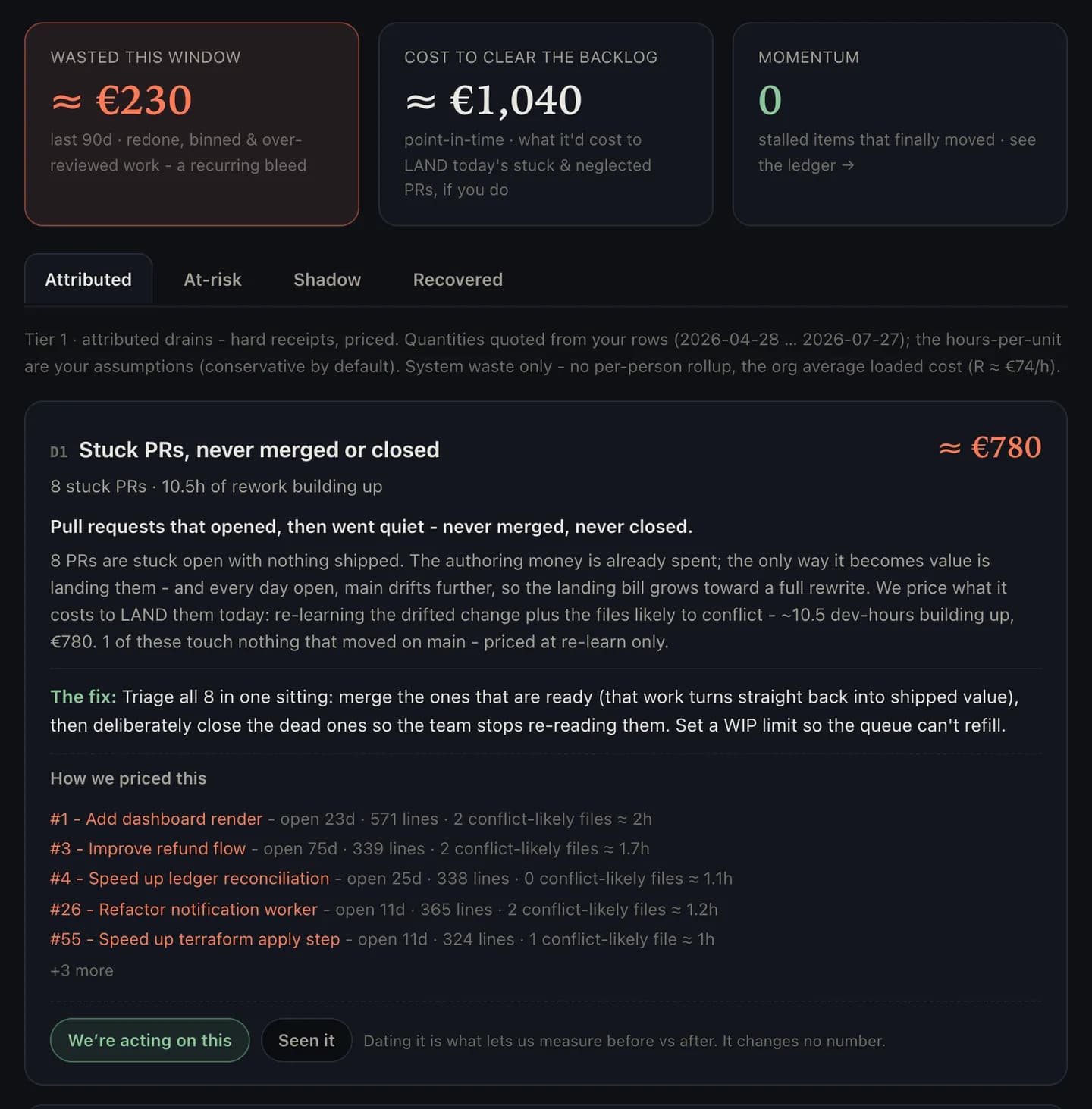
Jellyfish's bottleneck surface is Life Cycle Explorer, announced in January 2023: issues tracked through Jira workflows, with elapsed time bucketed into four phases ("refinement, work, review or deployment") and outliers surfaced for drill-down. That's useful aggregate arithmetic. It's also blind to anything Jira statuses don't encode. Busfactor's delivery trace works at the item grain across sources: where each piece of work actually waited, in which queue, behind which reviewer or dependency, with the receipts linked. Aggregate phase averages tell you review is slow; the trace shows you the eleven PRs and the one overloaded reviewer that made it slow. Different grain, different conversations on Monday.
Pricing and motion
Jellyfish is quote-only: no published prices, annual contracts, sales-led. That leaves only third-party estimates, and they are explicitly estimates, not vendor figures. Checked on 28 July 2026, they don't agree: CodePulse says $20-40 per developer per month and reports a $35,920 median annual contract across 91 purchases, with the smallest documented deals near $16,500; Vendr's marketplace listing reports a $57,535 median annual contract across 36 deals; a community write-up says roughly $35-50 per engineer per month and calls Jellyfish "impractical for teams under 30-50 engineers." None of those is a published minimum, and the spread between $16.5K and $57.5K is the point: nobody outside a sales cycle knows. Busfactor is self-serve with published per-developer tiers on the pricing page. Connect read-only and you see your first findings the same day, no sales call required. These are different worlds: they can't profitably serve the org that expenses a self-serve subscription, and we don't compete for the five-figure enterprise FP&A contract.
Who should pick which
| You are… | Pick |
|---|---|
| An enterprise where FP&A and engineering co-own the purchase | Jellyfish |
| Specifically after R&D tax-credit support this fiscal year | Jellyfish |
| Living with genuinely messy Jira you can't clean before rollout | Jellyfish |
| A CTO who needs finance numbers an auditor can re-derive | Busfactor |
| Under ~50 devs and outside their practical deal floor anyway | Busfactor |
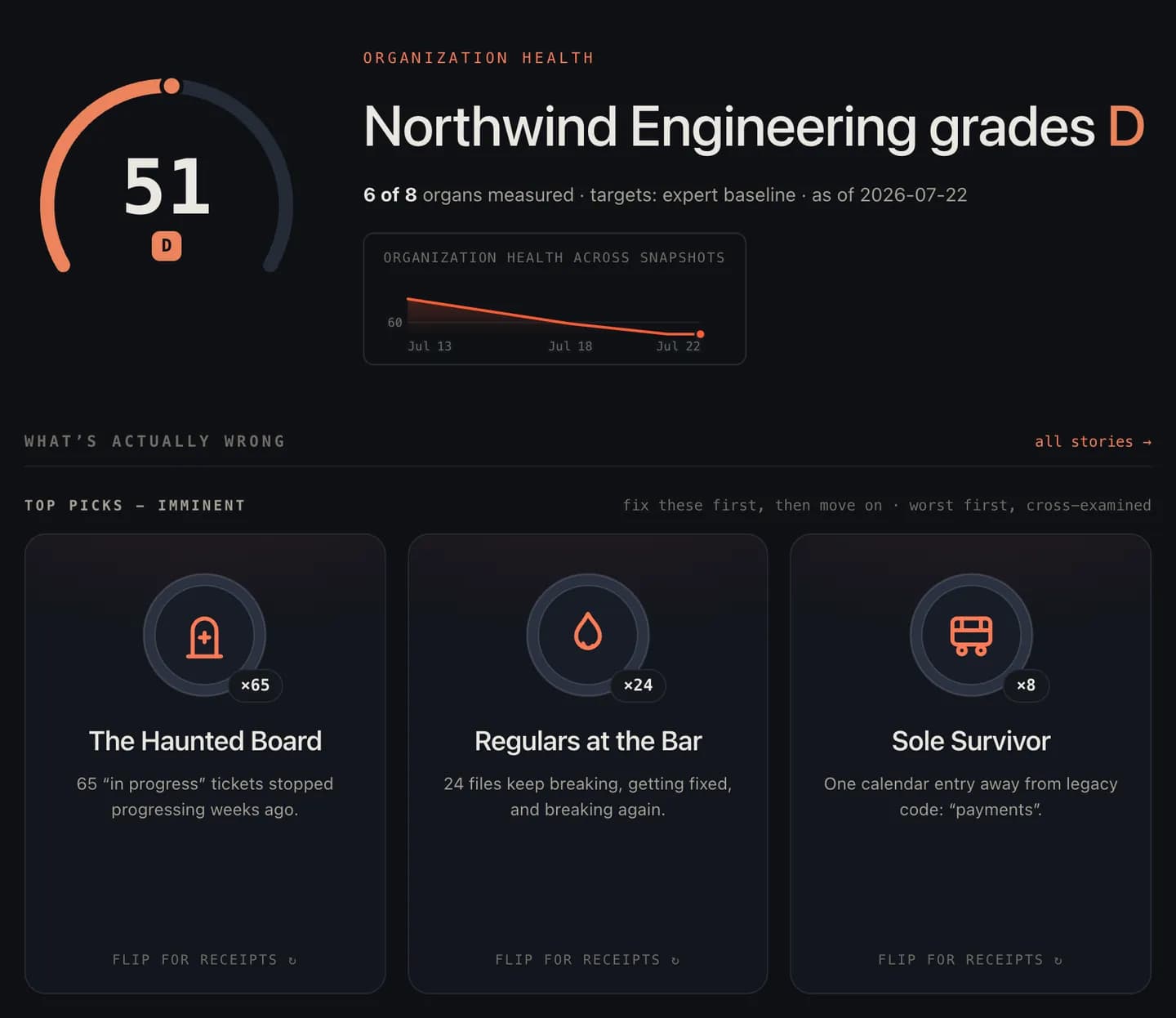
| After a diagnosis - graded verdicts, priced drains, payback on fixes - not rollups | Busfactor |
Whichever way you lean, ask both vendors the same evaluation questions, and make the reproducibility question non-negotiable, because it's your name on the capitalization memo, not the vendor's.
Frequently asked
How much does Jellyfish cost?
Jellyfish publishes no prices; it's quote-only with annual contracts. Third-party estimates, all checked 28 July 2026 and none of them vendor figures, disagree with each other: CodePulse says $20-40 per developer per month and reports a $35,920 median annual contract across 91 purchases, with the smallest documented deals near $16,500; Vendr's marketplace listing reports a $57,535 median annual contract across 36 deals; koalr's write-up says roughly $35-50 per engineer per month and calls Jellyfish impractical for teams under 30-50 engineers. Note that none of those is a published minimum. Treat all of it as estimate; the only real number is the quote they give you.
What is the Jellyfish Work Model?
The engine Jellyfish markets as patented: it reads the data exhaust from Jira and Git, then scores and splits each engineer's week into FTE fractions across projects and investment categories, with no timesheets. It's genuinely convenient, and it works on messy data. The catch is that the scoring function is not disclosed, so neither you nor your auditor can recompute how a person-week was split; you can only trust it.
Who is Jellyfish actually for?
Enterprise finance and engineering leadership together (FP&A workflows, R&D cost capitalization, tax-credit support, board rollups) at organizations big enough for a sales-led annual contract. If that's you, it's a credible incumbent. If you're a smaller org that wants finance numbers you can verify plus an actual diagnosis of where delivery hurts, that's the gap Busfactor was built for.
Receipts
- Jellyfish - the work allocations model (vendor blog)
- Jellyfish - Resource Allocations product page
- Jellyfish - Business Alignment solution page (AI-powered categorization)
- Jellyfish - DevFinOps product page
- Jellyfish - AI Impact product page
- Jellyfish - homepage (customer logos, 20M-PR corpus, AI agents)
- Jellyfish - named a Leader in the 2026 Gartner Magic Quadrant for Developer Productivity Insight Platforms
- Jellyfish - Life Cycle Explorer launch announcement (January 2023)
- CodePulse - Jellyfish pricing review (third-party estimate)
- Vendr - Jellyfish marketplace listing (third-party estimate)
- koalr - Jellyfish pricing write-up (third-party estimate)