GitClear vs LinearB (2026): Diff Forensics or Delivery
DIFF FORENSICS OR DELIVERY
GitClear vs LinearB for 2026 buyers: line-level code forensics against delivery flow, both pricing pages quoted, and the score neither will let you audit.
The band we grade against.
Illustrative example
TL;DR: GitClear and LinearB measure different layers of the same org. GitClear is code forensics: line-level analysis of what happened inside the diff (duplication, churn, moved code), plus the research corpus that owns the AI-code-quality narrative, from $14.95 per contributor across four git providers. LinearB is delivery intelligence: DORA, cycle time, an 8.1M-PR benchmark cohort, and PR automation, with seat minimums and an Enterprise tier gating the tracker and Slack. Each has an unauditable formula at its center. One scores your developers, one classifies your AI work. If the reason you're shopping is trust, the third lens below is the actual answer.
Written by a third vendor, Busfactor, so neither side gets flattered. All claims cite vendor pages as of July 2026; both pricing pages have drifted before and will again.
Two lenses, two buyers
GitClear is for leaders who believe the truth lives in the diff. Its engine classifies every changed line by operation - added, updated, deleted, moved, find-and-replaced, copy/pasted - and rolls them into Diff Delta, a weighted measure of "durable output, not volume." Its AI story is per-tool ROI ("which AI tools are actually earning their license") with line-level attribution claims. Its research, the largest public datasets on AI's effect on code quality, is cited across the industry press. It's the cheapest serious tool in the field and supports GitHub, GitLab, Bitbucket, and Azure DevOps on all paid tiers.
LinearB is for leaders who believe the truth lives in the flow. DORA and cycle-time analytics, the category's largest published benchmark cohort (8.1M+ PRs, 4,800 teams, banded Elite to Needs Focus), gitStream automation acting on PRs, surveys, an MCP server, and a 2026 Gartner MQ Leader badge. Scale and motion are bigger too: published per-seat pricing with minimums, and the enterprise checklist (SOC 2, SSO, on-prem agents) LinearB has and GitClear mostly matches (SOC 2 Type 2, ISO 27001, on-prem at its Enterprise tier).
These lenses are complementary. A team can ship fast through a clean pipeline while filling the codebase with duplicated slop, and GitClear would catch what LinearB can't see. The honest comparison is about which blind spot you can least afford.
Where GitClear wins
Line-level forensics nobody else ships. Moved-code detection, copy/paste tracking, churn windows. GitClear's published example filters 83.2M raw lines down to 2.5M credited lines, and the methodology disclosure (base scores per operation, a duplication filter, context scalars) is the most open in the category, even if the exact coefficients stay proprietary.
The research crown. Its 2026 Maintainability Gap report analyzed 623M changed lines from 2023-2026: code-block duplication up 81 percent, refactoring line-moves down 70 percent, within-commit copy/paste up 41 percent, error-masking constructs up 47 percent. If you want the evidence that AI-assisted speed is mortgaging maintainability, GitClear wrote it.
Price and provider breadth. Free entry tier; paid from $14.95/contributor/month annually; four git providers on every paid tier. LinearB's non-GitHub providers sit in its $59 × 50-seat Enterprise tier.
Where LinearB wins
Everything outside the diff. GitClear has no issue-tracker integration, no delivery pipeline view, no surveys, no forecasting, no Slack digests. It reads git, full stop. LinearB connects the tracker (Enterprise tier), detects deploys, benchmarks you against a live cohort, automates PR workflows, and ships the enterprise procurement checklist. As an org-wide operating system for delivery, it's not a contest.
Automation is a second clean win: gitStream routes reviewers, labels review-time estimates, and auto-approves safe changes - working automation deployed across thousands of orgs. GitClear's product acts on nothing; it reports.
The benchmark cohort. In-product bands from 8.1M+ PRs. GitClear offers research percentiles from its corpus, but not a live in-product peer comparison at that scale.
The formulas neither will show you
Here's what the two have in common, and it matters if trust is why you're shopping.
GitClear's flagship is a per-developer score with secret scalars. Diff Delta's base weights are published: copy/paste scores negative, new code positive, edits to year-old code highest. But the churn windows, context scalars, and language handling are proprietary, and the number lands on each individual developer. That's a per-person productivity score you can't fully audit; seniors will game it or resent it. Its AI attribution, likewise, blends usage APIs with "commit heuristics", which is more deterministic than ML fingerprinting, but the per-line resolution rules aren't disclosed.
LinearB's AI number is a threshold you can turn. Per its own 2026 release notes, the AI-assisted classifier's default confidence cutoff launched at 50, became configurable in March 2026, and was lowered to 25 in June 2026. Same history, different knob, different adoption chart, and the scoring model isn't disclosed. Its review-time labels come from an undisclosed ML model; no reproducibility claim appears anywhere.
Neither vendor offers the settling test: re-run last quarter, diff the bytes.
The intersection neither one covers
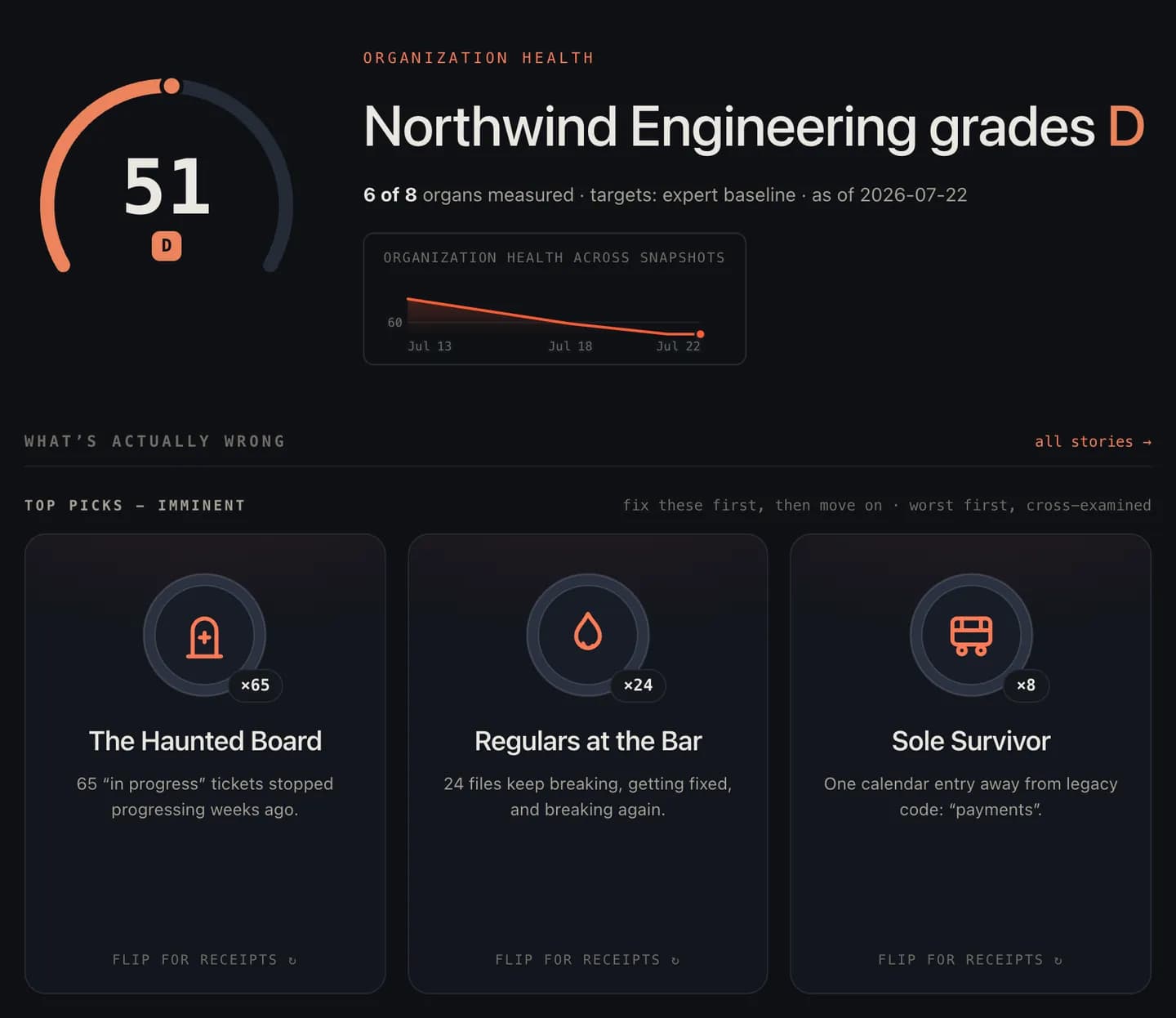
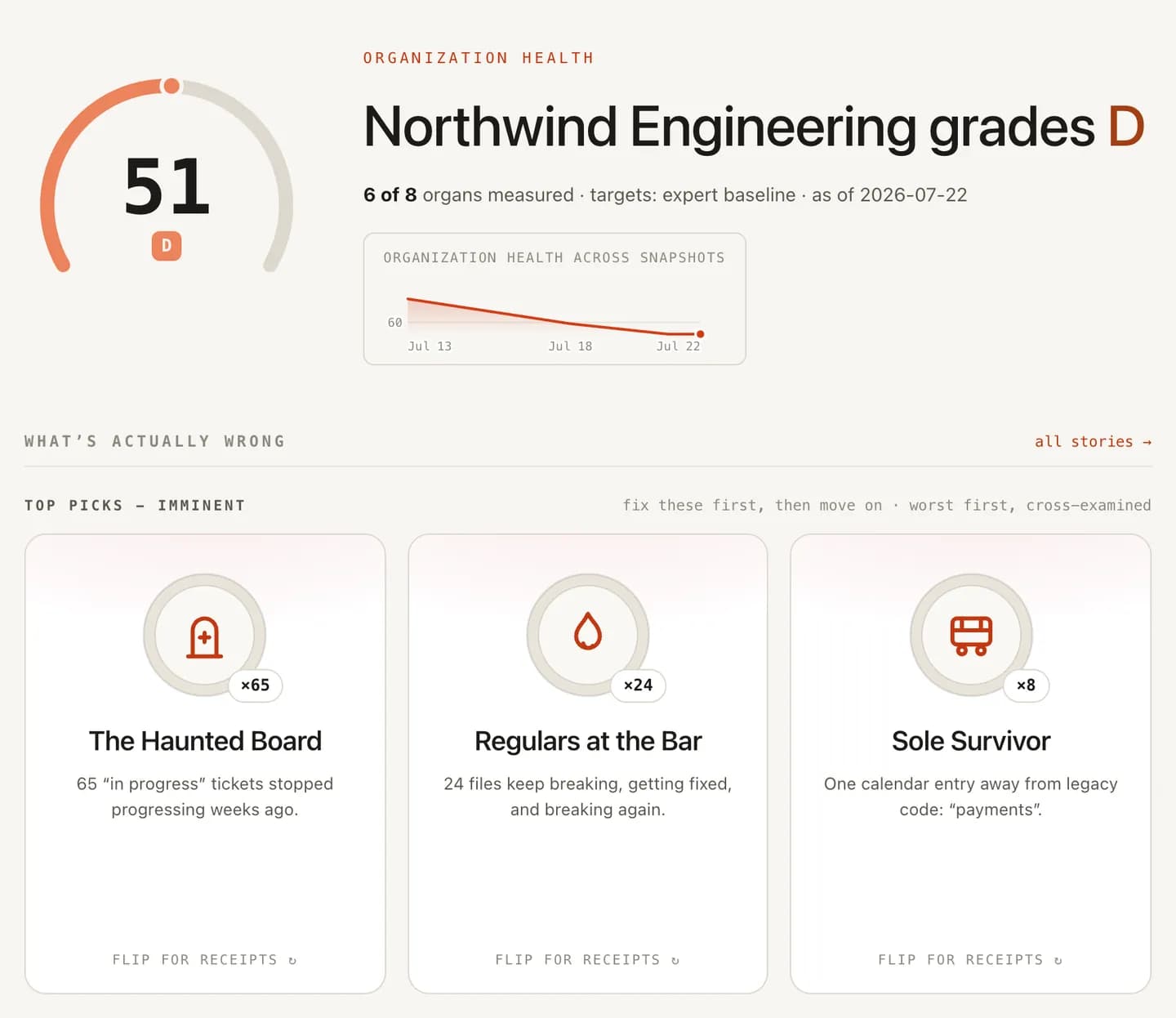
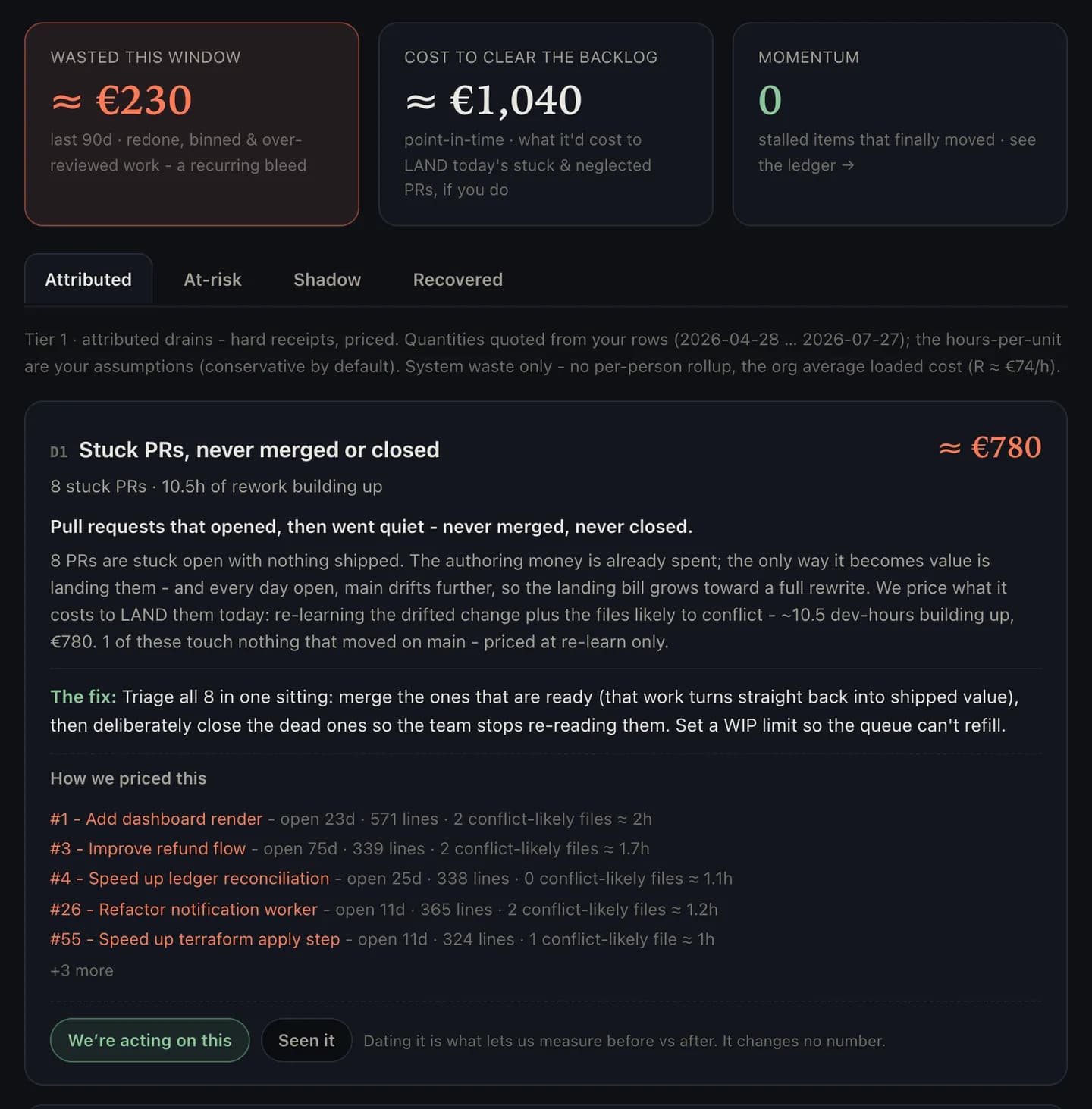
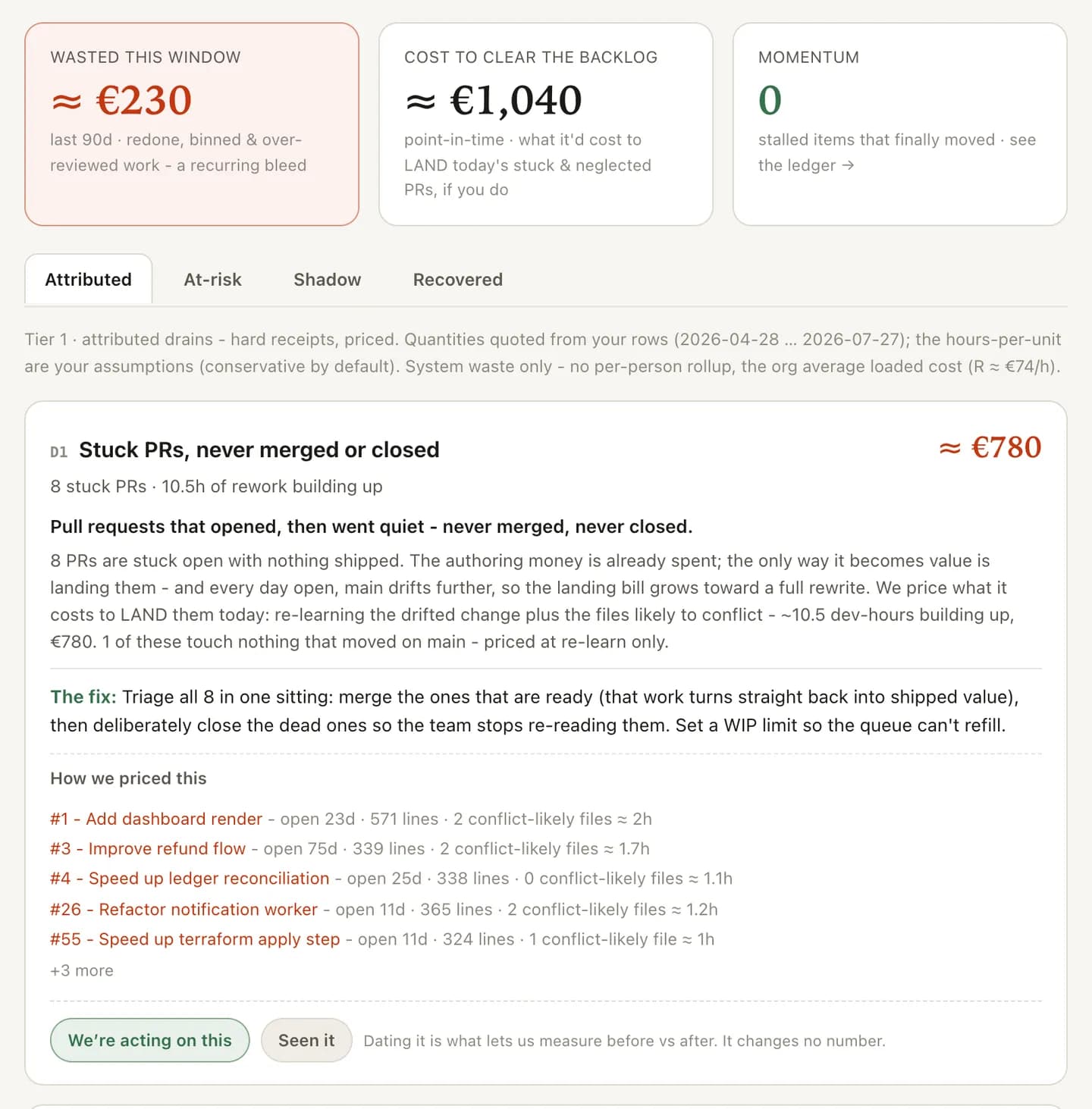
Maybe the diff-forensics case has convinced you (it convinced us; we cite GitClear's research with attribution), but a per-developer score is a line you won't cross. Maybe the delivery case has convinced you, but you want a verdict rather than dashboards. That intersection is Busfactor. Team-and-system grain, never a per-person composite: scorecards price the cost of losing someone, not a rank. AI attribution counts only quotable evidence (agent trailers, bot accounts) with blind spots disclosed - no heuristics, no threshold knob. And the product's core is the layer both of these vendors leave to you: judged verdicts with receipts on every claim (assessment), drains priced in your currency with payback estimates (money), all with zero LLM in the metric path and byte-identical re-runs, provenance printed on the export. Flat published pricing, self-serve.
The direct matchups, concessions first: Busfactor vs GitClear and Busfactor vs LinearB.
GitClear vs LinearB: the decision table
| You are… | Pick |
|---|---|
| Worried AI is quietly degrading your codebase; want line-level proof | GitClear |
| Multi-provider git estate on a small-team budget | GitClear |
| Want DORA, benchmarks, and PR automation as one operating system | LinearB |
| 50+ devs with the tracker and Slack in scope (Enterprise tier) | LinearB |
| Refuse per-person scores but still want the code-health diagnosis | Busfactor |
| Need numbers an auditor can re-run, plus a graded, priced verdict | Busfactor |
Ground yourself in DORA metrics explained before buying either lens; every tool here builds on those four keys. Adjacent matchups: LinearB vs Faros AI for the mid-market-versus-data-platform fork, and DX vs Swarmia for the survey-versus-telemetry fork.
Frequently asked
Are GitClear and LinearB actually competitors?
Less than the comparison suggests. GitClear reads the diff: line-level code-change analysis (moved, copy/pasted, churned code), Diff Delta as its effort measure, and per-tool AI code attribution - no issue-tracker data, no delivery pipeline view, no surveys. LinearB reads the pipeline: DORA, cycle time, benchmarks, PR workflow automation, with Jira and forecasting in its Enterprise tier. Some orgs run both. The comparison is real only when one budget has to pick one lens first.
Is GitClear cheaper than LinearB?
For small teams, clearly, as of July 2026. GitClear starts free (3 repos, 6-month window), with paid tiers from $14.95 per contributor per month billed annually, and all paid tiers include four git providers: GitHub, GitLab, Bitbucket, Azure DevOps. LinearB's Essentials is $29 per contributor per month with a 30-user minimum - a floor around $870 monthly - and its Enterprise tier ($59, 50-user minimum) gates issue-tracker data, Slack, forecasting, and non-GitHub providers. Under about 30 developers, LinearB's minimums decide the question by themselves.
Does GitClear score individual developers?
Yes - Diff Delta, its flagship metric, is computed and displayed per developer: a weighted credit score over line operations (copy/paste scores negative, new code positive, edits to year-old code highest), filtered and scaled by proprietary coefficients that are not fully public. GitClear publishes more of its methodology than almost anyone, but the per-person productivity score is exactly the pattern that gets gamed and resented. LinearB, to its credit, does not ship a per-developer ranking; its person-level scores are review-routing inputs, not performance grades.
Receipts
- GitClear - Diff Delta factors (published scoring methodology)
- GitClear - Pricing (as of July 2026)
- GitClear - AI Code Quality: the Maintainability Gap (2026 research)
- GitClear - AI-era attribution updates (usage APIs, commit heuristics)
- LinearB - Pricing page (as of July 2026)
- LinearB - Engineering Benchmarks report
- LinearB - 2026 release notes (AI Analytics threshold changes)
- LinearB - 2026 Gartner Magic Quadrant Leader announcement
- gitStream documentation - filter functions