Questions to Ask Before Buying Engineering Analytics
ASK BEFORE YOU BUY
The vendor-agnostic question list for evaluating engineering analytics: data honesty, team-versus-individual metrics, privacy, pricing, and exit costs.
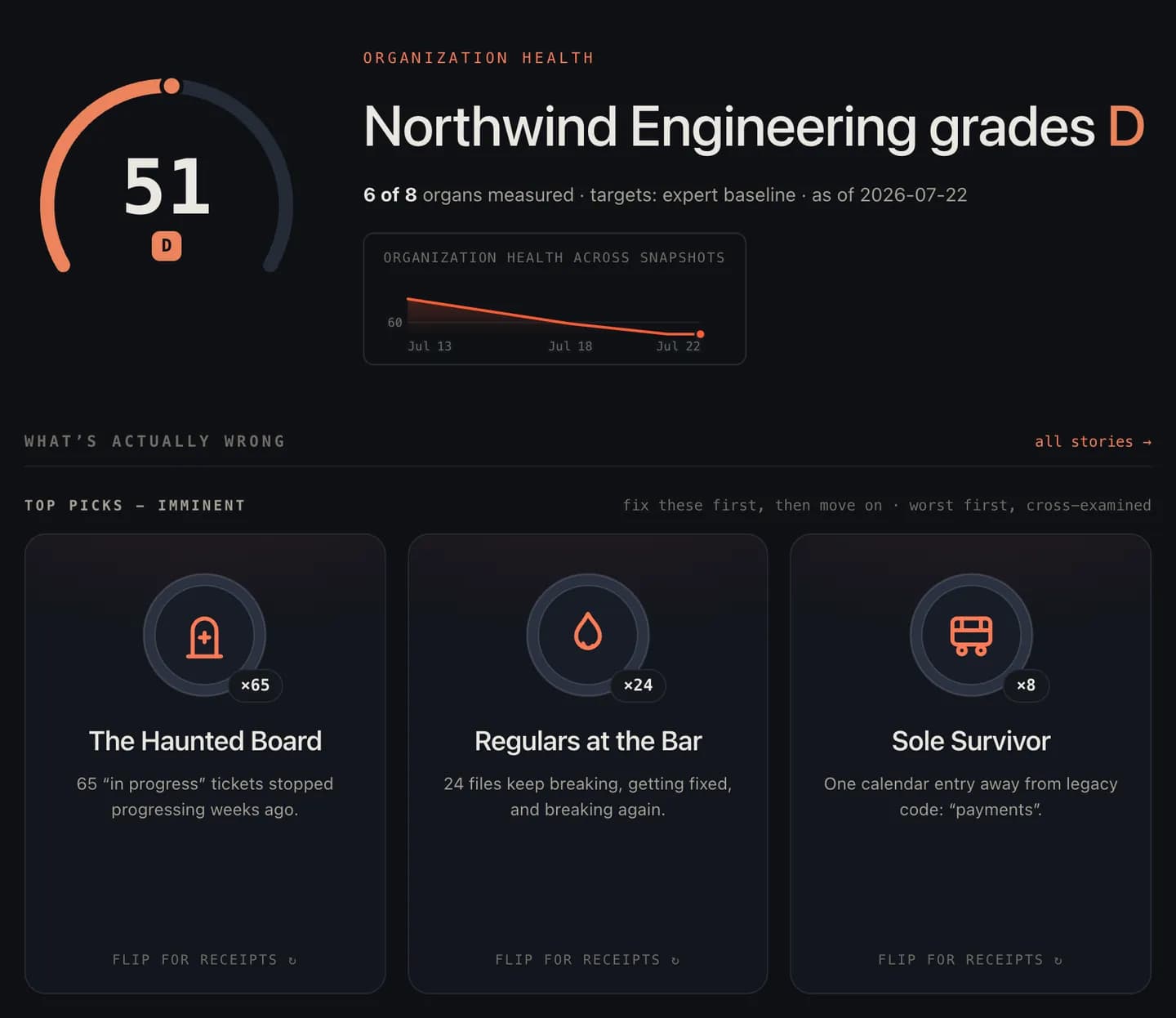
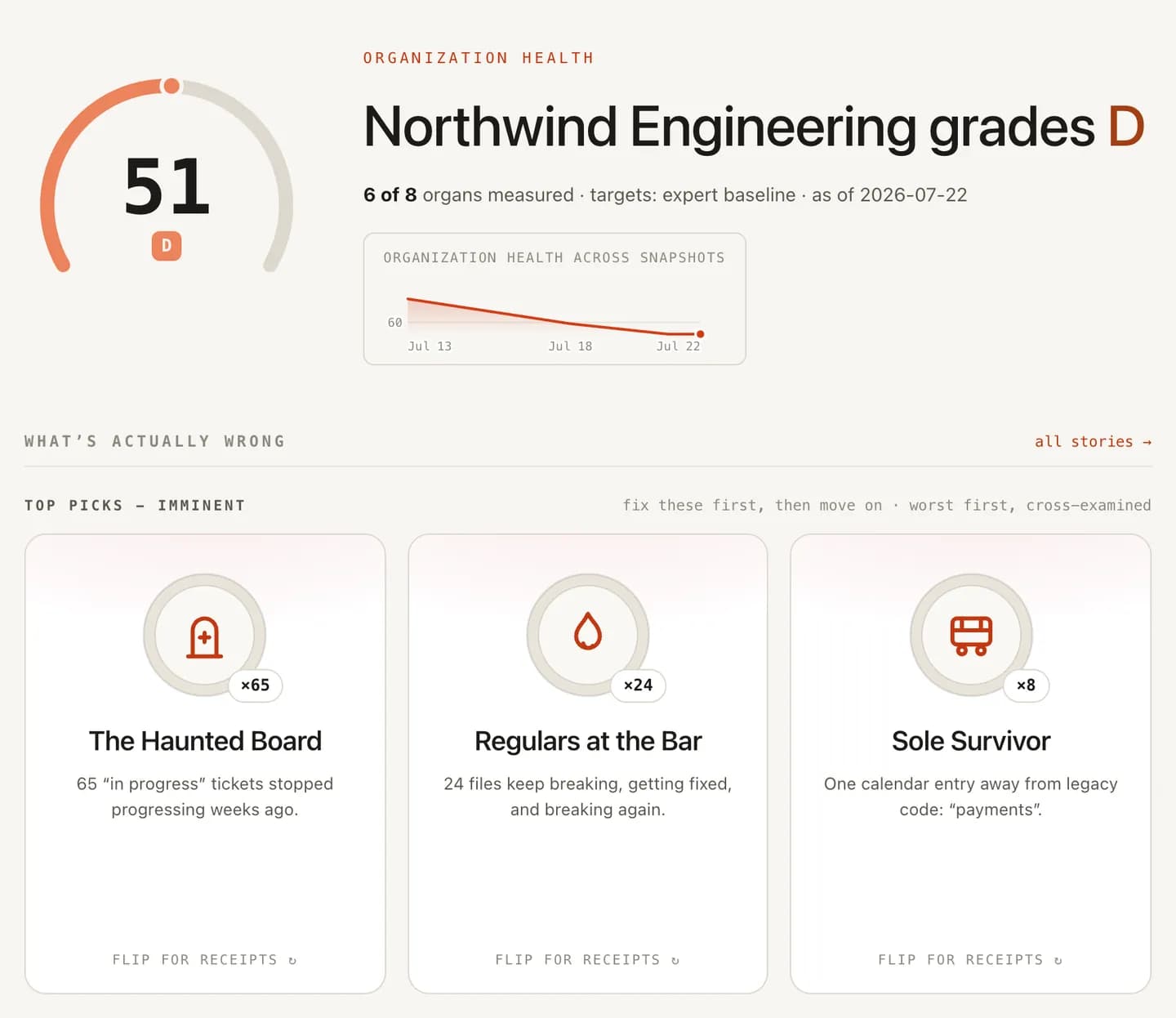
The band we grade against.
Illustrative example
TL;DR: Most engineering analytics purchases go wrong in the demo, where every chart is beautiful and every number is someone else's data. This is the question list that survives contact with a sales call, grouped into data honesty, people posture, benchmarks, privacy, pricing, and exit. Print it, ask all of it, and treat any dodged answer as the answer.
A vendor demo is a magic trick performed with cherry-picked data. The charts resolve, the insights land, and the one question that matters never comes up: will this be true about MY org's data? So here is the question list to bring, organized by what each group actually tests. It's vendor-agnostic on purpose; the buyer's guide covers the category itself.
Data questions: the receipts test
The foundation. A tool that fails here fails everywhere.
- Can every number drill down to its evidence? Click any metric, cycle time or review coverage or anything else, and demand the list of actual PRs, commits, and tickets behind it. A number you can't decompose is a number you can't defend in front of your team, and you will have to defend it.
- Are metric definitions documented, precisely? "Cycle time" has a half-dozen plausible start and end points, so which one is it? Where definitions are ambiguous, the vendor should tell you their choice and why, in writing.
- Are the numbers reproducible? Same input data, same numbers, every time. If the vendor can't commit to determinism, you'll be explaining to your CFO why last quarter's dashboard disagrees with this quarter's screenshot of it. This one question sorts the category faster than any feature matrix: when we read the major vendors' own methodology and deployment docs against it, most flunked. The receipts, vendor by vendor, are in the determinism audit.
- How does it handle the messy edges? Force pushes, squash merges, bot accounts, one human with three git identities, reverts. These aren't corner cases. They're Tuesday. Ask for the specific handling of each, and watch whether the answer is engineering or hand-waving.
- How far back does the backfill go? Trends need history. A tool that starts measuring from install day needs months before it can tell you anything about direction.
People questions: system or scapegoat?
The category's ethical fault line, and where your team's trust is won or lost before rollout.
- Does it rank individuals? If there's a leaderboard of humans - by commits, by "impact score," by anything - walk away. The SPACE research states that productivity cannot be measured by a single metric or dimension; a per-person composite score is exactly that mistake, sold as a feature. The full argument lives in why individual developer metrics backfire.
- What does the vendor refuse to build? The most revealing question on the list. A vendor with a principled answer ("no stack ranks, no firing signals, here's why") has thought about failure modes. A vendor answering "we give you the data, you decide" is handing you a loaded dashboard and skipping town. Two head-to-heads show the spread on this exact question: Busfactor vs Multitudes is two vendors who both refuse stack-ranks disagreeing over person-grain AI labels, and Busfactor vs Harness is what it sounds like when the telemetry comes from an agent on every developer's machine.
- Can names be anonymized, and who controls it? There are legitimate uses for per-person context (coaching, load-balancing, bus-factor risk) and illegitimate ones. Look for role-based access and anonymization controls, not all-or-nothing.
- Will engineers see their own data? Tools that show developers exactly what's computed about them earn trust; tools that report upward only, breed the gaming they deserve.
Benchmark questions: compared to what?
- Where do the benchmarks come from? Any tool showing "industry comparison" bands owes you the source, sample, and date. Ask specifically whether their DORA-style tiers reflect that DORA's 2025 report retired the famous elite/high/medium/low model in favor of team archetypes. A vendor still selling "elite" badges off a retired rubric hasn't read their own references lately.
- Are benchmarks definition-matched? A percentile is meaningless if their "cycle time" starts at first commit and yours starts at ticket creation. Same-definition or it's decoration.
Privacy and security questions
- What scopes, exactly, and are they read-only? Minimum access for the features used. Write access to your repos should be a hard no for an analytics product.
- Where does the data live, how long, and how does it die? Retention policy, deletion on churn, and subprocessor list: the boring questions whose absence gets expensive later.
- Can you exclude sensitive repos or people? Contractor agreements, works councils, and common decency all occasionally require carve-outs. It should be a setting, not a support ticket.
Pricing questions: find the unit
- Who counts as a seat? Committers? Viewers? Everyone in the git history including the intern who left in 2023? Per-seat pricing with a generous seat definition is a price escalator wearing a trench coat.
- What happens at 2× headcount? Get the growth math in writing. Flat-tier models make this predictable; per-seat models make it a negotiation you'll lose while growing.
- Which features live behind which add-on? Sum the modules you'd actually need before comparing anything to anything.
Exit questions: the ones nobody asks
- Can you export your data - metrics, history, findings - in a usable format?
- What does month one after cancellation look like? If the answer is "you lose all history and start from zero elsewhere," weigh that lock-in as part of the price.
How to run the actual evaluation
Don't evaluate the demo; evaluate your data. Connect a real (non-sensitive) repo read-only, then check three things in the first week: one metric verified by hand against the tool's number, one insight you didn't already know, and one uncomfortable truth - a silo, a dead review queue, a delivery stage quietly eating a week. A tool that flatters you in week one is optimizing for renewal rather than truth.
And if the honest conclusion of the evaluation is "we could build the two metrics we need ourselves" (sometimes correct!), do the build-vs-buy math with real loaded-cost numbers before anyone books a weekend for it.
Frequently asked
How do I evaluate an engineering analytics tool?
Run your own data through it before believing anything. Connect read-only, pick one metric you can verify by hand - say, cycle time on last month's PRs in one repo - and check the tool's number against reality. Then test the drill-down: every metric should decompose into the real PRs and tickets behind it. A tool that fails the receipts test in the demo will fail it in production.
What is the biggest red flag in an engineering analytics tool?
A ranked list of developers, or any single composite score per person. The SPACE researchers are explicit that productivity cannot be measured by a single metric, and a tool built to rank humans will be gamed by humans within a quarter - after which none of its data can be trusted. Second-biggest: metrics with no documented definitions.
Should engineering analytics tools have access to our code?
Ask exactly what scopes the tool requests and why. Much of the category's value - timing, review flow, ownership structure, ticket movement - comes from metadata rather than file contents, though some analyses legitimately need more. The standard to demand: read-only access, the minimum scopes for the features you actually use, and a clear data-retention and deletion policy.