LinearB vs Swarmia (2026): Scale or Transparency?
SCALE OR TRANSPARENCY
Hover or focus to flip ↻LinearB vs Swarmia, compared fairly as of July 2026: benchmarks and automation against Slack loops and honest AI detection - and the question neither answers.
TL;DR: LinearB is the scale play: a 2026 Gartner MQ Leader with the category's largest published benchmark cohort (8.1M+ PRs) and gitStream automation that actually acts on your PRs, priced per contributor with 30- and 50-seat minimums, and with Jira and Slack gated to Enterprise. Swarmia is the transparency play: the most honestly documented methodology in the category, a shipped Slack habit loop, and self-serve pricing that starts free. Under ~50 developers, Swarmia usually wins on access; at enterprise scale with a benchmarks-and-automation shopping list, LinearB does. And both share one trait most comparisons skip: a probabilistic layer inside their load-bearing AI numbers and no reproducibility claim anywhere. Everything below is cited to their own pages, as of July 2026.
First, the disclosure this page owes you: we build Busfactor, a competitor to both of these products. A comparison of two rivals written by a third should earn your trust the hard way, so the rules here are strict: every load-bearing claim links to LinearB's or Swarmia's own published pages, prices are dated (July 2026; both pricing pages have drifted before and will again), and each tool's genuine wins over the other are stated plainly. Our own pitch is quarantined in the last section, clearly labeled. If it helps: we say considerably nicer things about both of them here than they say about each other.
Who each tool is for
LinearB sells to engineering leadership at scale. The pitch is comparative: see your cycle time, PR size, and deploy frequency against 8.1M+ PRs from 4,800 teams, banded into Elite/Good/Fair/Needs Focus tiers, then use gitStream to automate the fixes. It's a 2026 Gartner MQ Leader with SOC 2, SSO, on-prem agents, five git platforms, and Monte Carlo forecasting on the enterprise checklist.
Swarmia sells to teams that want to run themselves better. The center of the product is the working agreements loop: a curated catalog of team norms (WIP limits, review velocity, collaboration) with targets the team sets, enforced by Slack-native nudges and digests. Around it: DORA metrics, Investment Balance for cost allocation, and rule-based software capitalization with SOC 1 and SOC 2 Type 2 behind it.
The stereotype - LinearB for VPs, Swarmia for teams - is unfair to both but directionally useful. LinearB's artifacts point up (benchmarks, exec dashboards, forecasts); Swarmia's point sideways (nudges, agreements, digests in the channel where work happens).
Where LinearB beats Swarmia
- The benchmark cohort. No self-serve rival matches 8.1M+ PRs across 4,800 teams in 42 countries, in-product, in both pricing tiers. Swarmia's benchmarking story is modest by comparison. If "how do we compare to thousands of teams" is your first question, this row decides it.
- Automation that acts. gitStream routes reviews to code experts, labels estimated review time, auto-approves low-risk changes, and flags sensitive paths. Programmable, per-PR, shipped. Swarmia's Slack nudges are a soft act-layer; gitStream changes what happens to the PR itself.
- The enterprise checklist. Five git platforms, on-prem agents, Monte Carlo forecasting, and the Gartner badge. Swarmia is certified (SOC 1, SOC 2 Type 2) but doesn't match the breadth of platform and deployment options.
- The trial: 45 days, full platform, no card. Genuinely the most generous evaluation window in the category.
Where Swarmia beats LinearB
- Pricing accessibility. Swarmia is free up to 9 developers,
then, as their page read on 28 July 2026 with annual billing selected, single-feature plans
from 4 €/dev/month (AI adoption and cost) through 22 €/dev/month (Productivity & AI impact,
where "Code, issue & DORA metrics" sit), or Standard at 42 €/dev/month for all of it. We
found no published seat minimum. LinearB's Essentials is
$29/contributor/month billed annually with a 30-seat minimum (
$870/month floor), and the features most buyers assume are standard - Jira, Azure Boards, Slack, Teams - sit in Enterprise at $59/contributor/month with a 50-seat minimum ($2,950/month floor). A 20-person team simply cannot buy LinearB's tracker integration at a 20-person price. - Methodological transparency. Swarmia's AI-detection docs grade their own signals by confidence tier and openly state where they overreport. LinearB's equivalent, a classifier whose scoring model is not disclosed, is documented mostly through release notes announcing threshold changes. When a vendor tells you the limits of its own measurement, believe the rest of its docs more.
- The shipped habit loop. Working agreements with Slack nudges are in Swarmia's cheapest paid tier. LinearB gates Slack/Teams delivery to Enterprise. For a team trying to build a review-speed habit rather than report on one, that's the difference between a tool the team feels daily and a dashboard leadership checks monthly.
- Predictable metering. LinearB's automation layer is credit-metered: one automated PR consumes 100 credits against a 1,000-1,500/month allowance, roughly 10-15 automated PRs before overage billing at $0.015/credit. Swarmia has no equivalent meter to model.
The AI-measurement fork (read this row twice)
Both products now lead with AI impact measurement, and this is where a buyer should slow down, because the two numbers are built differently and neither is reproducible.
LinearB classifies work as AI-assisted via a confidence threshold. Per their own 2026 release notes, the default launched at 50, became org-configurable in March 2026, and was cut to 25 in June 2026 "for improved detection accuracy." The model producing the confidence score is not disclosed. Turn the knob and the same history tells a different adoption story; when the vendor moved the default mid-year, every existing chart quietly changed meaning.
Swarmia counts four signals, graded in
their own docs:
AI co-authored commits, Made-with trailers, and AI PR labels (high confidence:
deterministic facts), plus "commits made by an author who used an AI tool within the
previous 24 hours" (low confidence, and their docs say it "can result in overreporting").
The honest grading is admirable; the low-confidence signal still ships inside the headline
number by default. There's also an AI auto-categorizer inside
Investment Balance, an opaque
classifier sitting inside the cost numbers a CFO may capitalize.
Swarmia's method is the more transparent of the two by a distance. But transparency about a heuristic doesn't make it re-runnable, and neither vendor claims anywhere that re-running a past period reproduces the same output. (What a fully deterministic version of this measurement looks like, and what it costs in coverage, is the subject of our determinism audit of the whole category.)
Pricing side by side (both pages checked 28 July 2026)
Swarmia restructured its plans during 2026. The "Lite" tier at €20 that earlier comparisons (ours included) quoted is no longer on their page. Swarmia's figures below are the annual-billing prices their toggle shows by default; a monthly option exists and costs more.
| LinearB | Swarmia | |
|---|---|---|
| Entry | $29/contributor/mo (annual), min 30 seats | Free ≤9 devs, then single-feature plans from 4 €/dev/mo |
| Issue metrics | Enterprise: $59/contributor/mo, min 50 seats | "Productivity & AI impact" plan, 22 €/dev/mo, or Standard 42 € |
| Everything bundled | Enterprise: $59/contributor/mo | Standard 42 €/dev/mo; Enterprise 52 € adds on-prem, HRIS, professional services |
| Practical floor | ≈ $870/mo (Essentials), ≈ $2,950/mo (Enterprise) | €0 |
| Metering | Credits on automation/AI (100/automated PR) | None published |
| Trial | 45 days, no card | Free tier + trial, no card |
One row we deliberately left out: which Swarmia plan carries Slack and Teams delivery. "Chat notifications" is listed as a platform feature and "Survey reminders on Slack" sits in the 8 € surveys plan, but the pricing page does not break chat delivery out per plan, so we are not going to tell you a tier we cannot read off the page.
Sources: linearb.io/pricing, swarmia.com/pricing, Swarmia docs on plans and billable seats. Both drift; re-verify before buying.
Where they're more alike than either admits
- Both are per-seat products: the bill grows every time you hire.
- Both ship an LLM assistant and MCP server (LinearB's MCP went GA in 2026; Swarmia AI answers plain-language questions), and neither claims its assistant can only quote, rather than generate, numbers.
- Both keep a probabilistic layer inside a load-bearing number: LinearB's tunable threshold, Swarmia's default-on 24-hour heuristic and Investment categorizer.
- Neither makes a reproducibility claim, anywhere in their public material.
- And to both vendors' credit: neither stack-ranks developers. That pathology lives elsewhere in this market.
Who should pick which
| You are… | Pick |
|---|---|
| 100+ devs, want live peer percentiles as the core artifact | LinearB |
| Sold on automation acting on PRs (routing, labels, auto-approval) | LinearB |
| Multi-git estate, on-prem requirement, forecasting on the RFP | LinearB |
| Under ~50 devs and need tracker data without a 50-seat floor | Swarmia |
| Building team habits - the Slack loop is the product you want | Swarmia |
| You read methodology docs before buying and reward honesty | Swarmia |
For adjacent matchups: LinearB vs Jellyfish covers the enterprise-finance flank, Swarmia vs Jellyfish the capitalization face-off, and LinearB vs DX the telemetry-vs-survey fork.
The pitch we quarantined
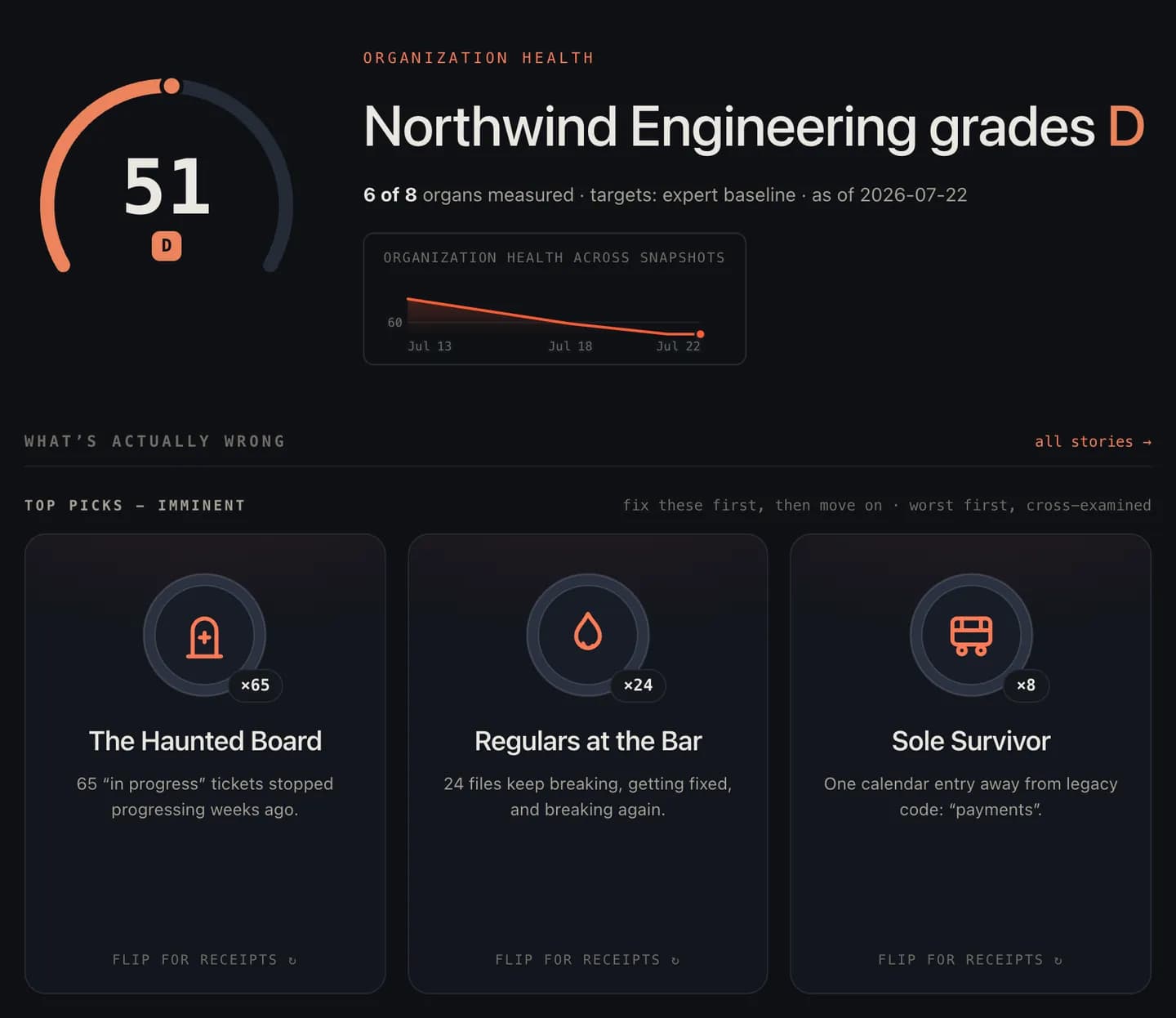
It exists for an honest reason. Both products above are good. Both are also structurally alike in the one place a CTO, CFO, or auditor eventually pushes: neither of their AI-adoption numbers can be re-derived by the person being asked to trust it. One is a tunable threshold over an undisclosed model; the other is three honest signals plus an admitted-overreporting heuristic, with an AI categorizer inside the finance numbers.
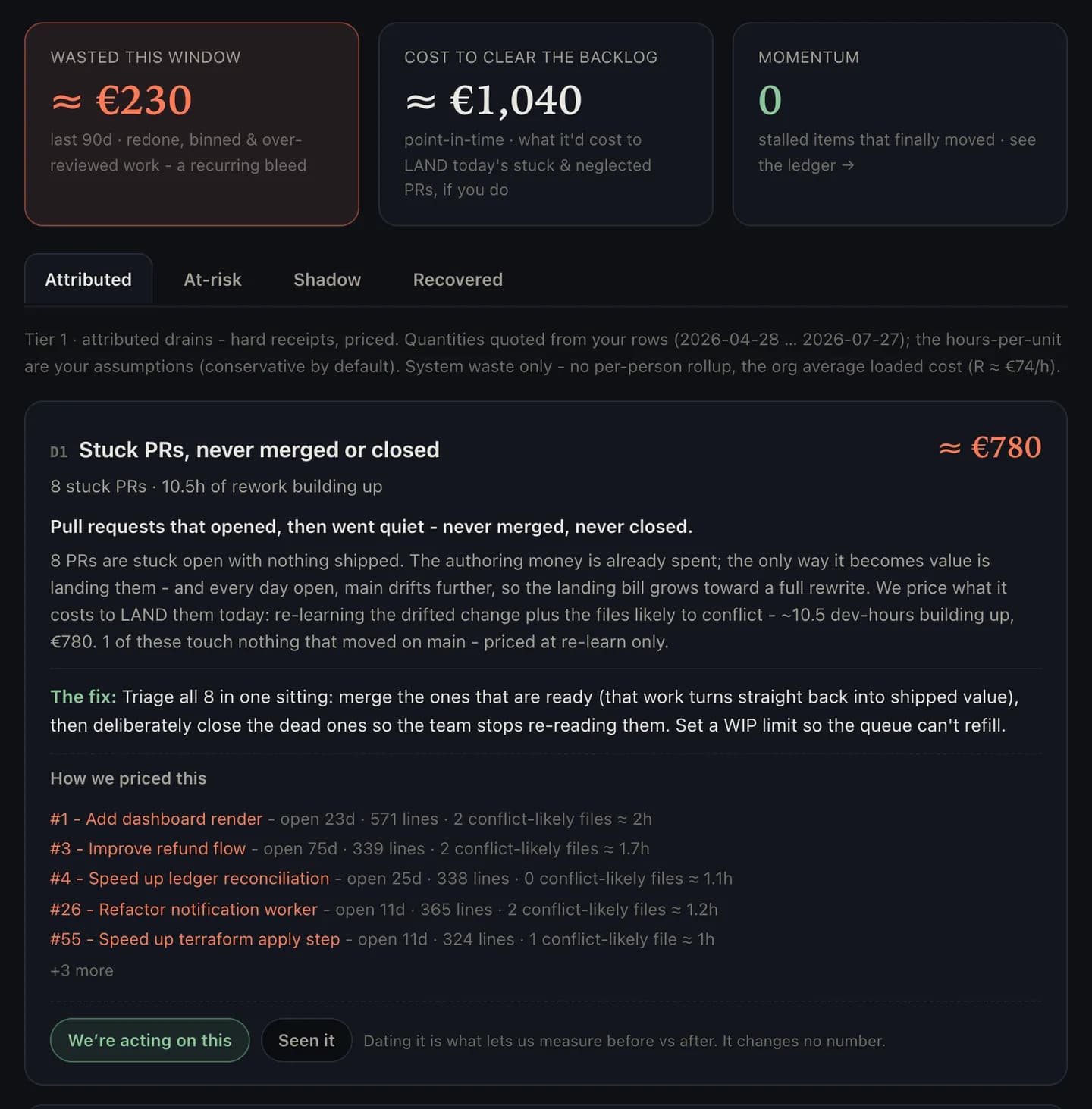
Busfactor's bet is the opposite trade: zero models in the metric path, AI attribution from deterministic evidence only (agent trailers, bot accounts) with blind spots disclosed rather than estimated over, and exports that print their provenance - run id, engine version, ruleset version, content hash - so re-running a past period byte-identically is a test you can actually perform. On top of that sits the layer neither LinearB nor Swarmia ships: a graded verdict with receipts attached and consequences priced, instead of dashboards to interpret. Per-developer pricing at a lower rate than either, nothing gated behind a 50-seat floor.
We've written the same fair-comparison treatment against each of them, Busfactor vs LinearB and Busfactor vs Swarmia, with the concessions running the other way too. Read those with the same skepticism you brought here.
Frequently asked
Which is cheaper, LinearB or Swarmia?
For small teams, Swarmia - it's free up to 9 developers. Past that, note that Swarmia restructured its plans during 2026 and the €20 Lite tier earlier comparisons quote is gone: checked 28 July 2026, their page shows single-feature plans from 4 €/developer/month, a 22 € plan carrying 'Code, issue & DORA metrics', Standard at 42 € for the bundle and Enterprise at 52 €, all per developer per month billed annually. LinearB's Essentials tier is $29/contributor/month billed annually with a 30-seat minimum (a floor around $870/month), and Jira plus Slack delivery sit in Enterprise at $59/contributor/month with a 50-seat minimum. Above roughly 50-100 developers the per-seat totals converge and the real question becomes which gated features you need. Both pages drift; re-check before you buy.
How do LinearB and Swarmia detect AI-assisted work?
Differently, and the difference matters. LinearB classifies work via a confidence-threshold model: per their 2026 release notes, AI Analytics launched in February 2026, the default threshold became configurable in March 2026, and in June 2026 the default was lowered from 50% to 25%; the underlying model is not described in those notes. Swarmia uses four signals its own docs grade by confidence: AI co-authorship, tool trailers, and PR labels are deterministic high-confidence facts, while the fourth - commits by someone who used an AI tool in the previous 24 hours - is graded low confidence and their docs admit it can overreport. Swarmia's is the more transparent method; neither number re-runs reproducibly with the low-confidence layer or a tunable threshold inside.
Should I pick LinearB or Swarmia?
Pick LinearB if you want live peer benchmarks from a huge cohort, automation that acts on PRs via gitStream, forecasting, or a heavier enterprise checklist - and you can absorb the seat minimums. Pick Swarmia if you're under about 50 developers, want the Slack working-agreements loop, or value a vendor that documents its own measurement limits. If your CFO or auditor needs to re-derive the numbers, read both AI-measurement docs first - that's where the two products are most alike, and where a third option may fit better.
Receipts
- LinearB - Pricing page (as of July 2026)
- LinearB - 2026 release notes (AI Analytics threshold changes, MCP)
- LinearB - Engineering Benchmarks report (8.1M+ PRs, 4,800 teams)
- gitStream documentation - filter functions (codeExperts, estimatedReviewTime)
- LinearB - 2026 Gartner Magic Quadrant Leader announcement
- Swarmia - Pricing (as of July 2026)
- Swarmia - AI tool detection and filters (help docs)
- Swarmia - Working agreements product page
- Swarmia - Investment Balance product page
- Swarmia - Software capitalization product page