Busfactor vs LinearB (2026): Cohort or Checkable Numbers
COHORT OR CHECKABLE NUMBERS
An honest LinearB alternative comparison: where their benchmarks and automation win, where our checkable numbers win, and who should pick which tool.
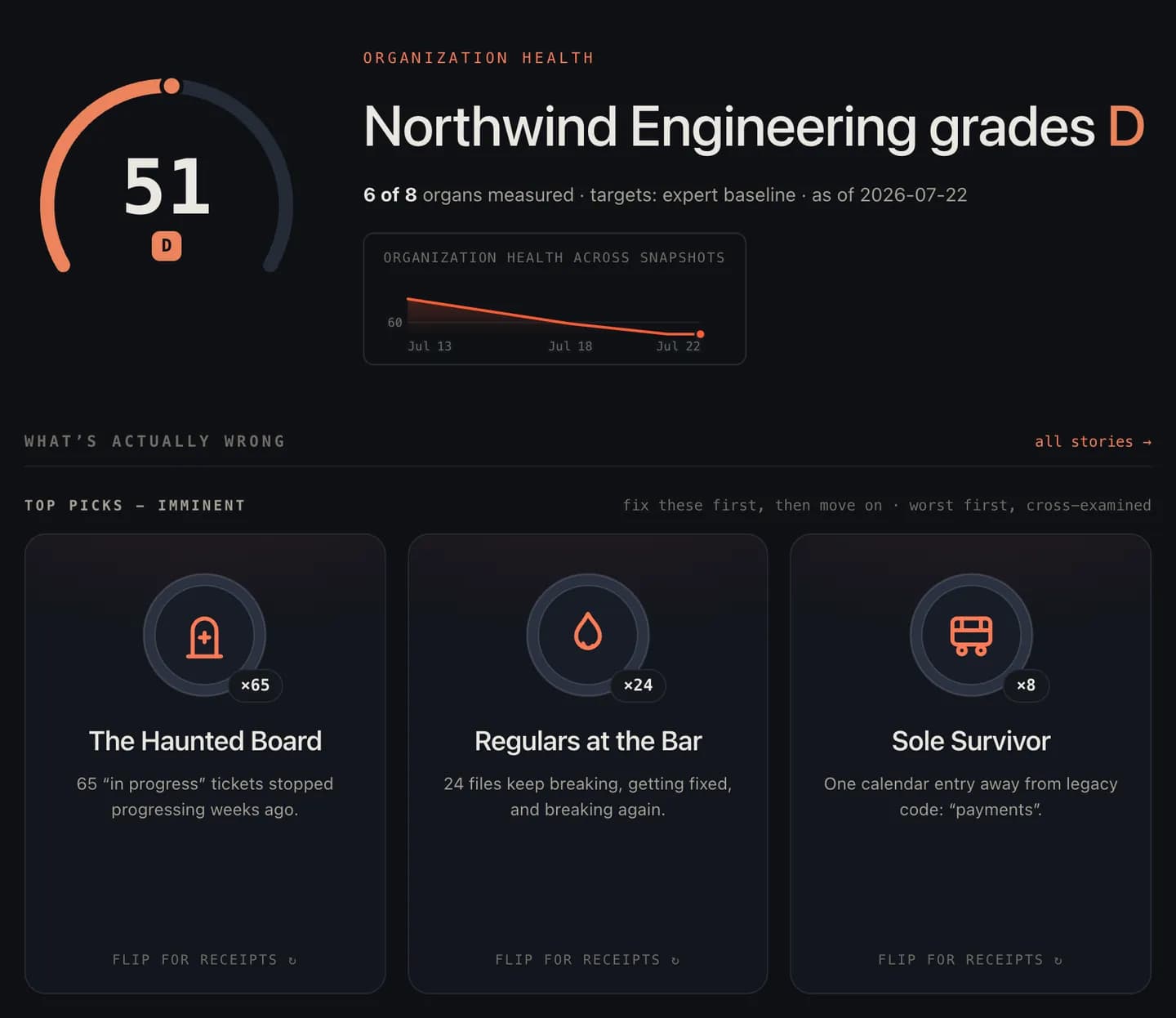
The band we grade against.
Illustrative example
TL;DR: LinearB is the biggest name in software engineering intelligence: a Gartner Leader with the category's largest published benchmark cohort and real PR automation. If you want live peer percentiles and workflows that act on PRs, it's a strong buy. The honest case for Busfactor as a LinearB alternative is different machinery: numbers with zero models inside them that re-run byte-identically, a verdict layer that grades your org and prices the fixes, and nothing gated behind a 50-seat Enterprise floor. Below: what each tool genuinely does better, with every claim cited.
Comparison pages written by vendors are usually strawman demolitions. This one tries to be the page we'd want to read ourselves: LinearB's real strengths conceded plainly, our differences stated checkably, and a straight answer on who should buy which. Where we cite a LinearB number, it links to their page; prices are as published in July 2026 and worth re-verifying, because pricing pages drift.
What LinearB genuinely does better
The benchmark cohort. LinearB's engineering benchmarks are built on 8.1M+ PRs from 4,800 engineering teams across 42 countries, banded into Elite/Good/Fair/Needs focus tiers across "20 metrics spanning the full SDLC" (cycle time, pickup time, PR size, deploy frequency, and more), as published in July 2026. That is live comparative data at a scale no small vendor can conjure, and it's available in both pricing tiers. Busfactor's benchmark bands are published, cited reference points - honest, but not percentiles of a live peer population. If in-product "how do we compare to 4,800 teams" is your top requirement, LinearB wins that row today, full stop.
Workflow automation. gitStream is shipped, programmable PR automation: route reviews to code experts, label estimated review time, auto-approve low-risk changes, flag sensitive paths. Busfactor deliberately doesn't act on your PRs (we observe and prescribe), so if "make it happen automatically" is the ask, that's LinearB's row too.
Enterprise checklist. Their pricing page lists SOC 1 Type II, SOC 2 Type II, ISO/IEC 27001 and GDPR, plus on-prem agents, developer surveys, Monte Carlo forecasting, and four git providers (GitHub, GitLab, Bitbucket, Azure DevOps, with cloud and on-prem variants listed separately) as of July 2026. On top of that, a Leader placement in the inaugural 2026 Gartner MQ. Busfactor is GitHub-first today and doesn't yet hold those certifications. If your procurement gate requires them now, we're not going to bluff you through it.
Where the numbers stop being checkable
The split between us is architecture, and it starts with the AI number.
The AI number is a threshold you can turn. LinearB's AI Analytics classifies work as AI-assisted via a confidence threshold. Per their own release notes, AI Analytics launched in February 2026, the default threshold became org-configurable in March 2026, and in June 2026 "the default AI interaction confidence threshold has been lowered from 50% to 25%." Two consequences follow. First, "how much of our work is AI-assisted" is a tunable probability, not a fact. Set the knob differently and the same history produces a different adoption story. Second, when the vendor moved the default mid-year, every chart drawn under the old default quietly changed meaning. The model producing the confidence score is not described in that public material. (How to measure this deterministically instead, and what that trade costs in coverage, is covered in how to measure AI adoption.)
Other undisclosed models in load-bearing places. gitStream's estimatedReviewTime
labels PRs using
an ML model based on PR size and file types -
useful nudge, unauditable number. Monte Carlo forecasting is Enterprise-gated and its inputs
aren't documented publicly. And the
benchmarks report doesn't disclose the
percentile math behind its band cut-points. None of this is unusual for the category; our
determinism audit found the same pattern across
the field. But "unusual" and "auditable" are different words.
No reproducibility claim. Nothing in LinearB's public material offers the test that settles all of this: re-run a past period and diff the output. Busfactor's exports print their provenance - run id, engine version, ruleset version, content hash - precisely so that test is one you can actually perform.
The pricing mechanics, side by side
As of July 2026, from LinearB's pricing page:
- Essentials: $29/contributor/month, billed annually only, minimum 30 billable users - a practical floor around $870/month. Includes git metrics, DORA, benchmarks, gitStream, surveys, MCP.
- Enterprise: $59/contributor/month, minimum 50 users, which puts the floor around $2,950/month. This is the tier where Jira and Azure Boards integration, Slack/Teams delivery, Monte Carlo forecasting, resource allocation, cost capitalization, and non-GitHub git providers live.
- Credits meter the automation/AI layer: 1,000/month on Essentials, 1,500 on Enterprise; "one automated pull request consumes 100 credits", with additional credits "starting at $0.015", so the bundled allowance covers roughly 10-15 automated PRs a month before metering starts. The page also allows exceeding the allocation at no charge in any two months a year, up to 120% of the standard allocation.
- "A 45-day free trial, with no commitment or payment method required" - genuinely generous, worth using.
The structural point a buyer should register: issue-tracker data and chat delivery, table stakes in most of the category, sit behind the $59-times-50-seats tier. Busfactor's model is the opposite bet: per-developer tiers with no seat cap and no feature gating, published on the pricing page, with every capability in every paid tier and no per-seat escalator as you hire. Which model is cheaper depends on your headcount; which is more predictable doesn't. (The general framework for pricing-model due diligence is in the buyer's guide.)
What Busfactor does that LinearB doesn't
LinearB hands you dashboards, benchmark bands, and automation. What it doesn't hand you is a stance. Busfactor's product is the stance:
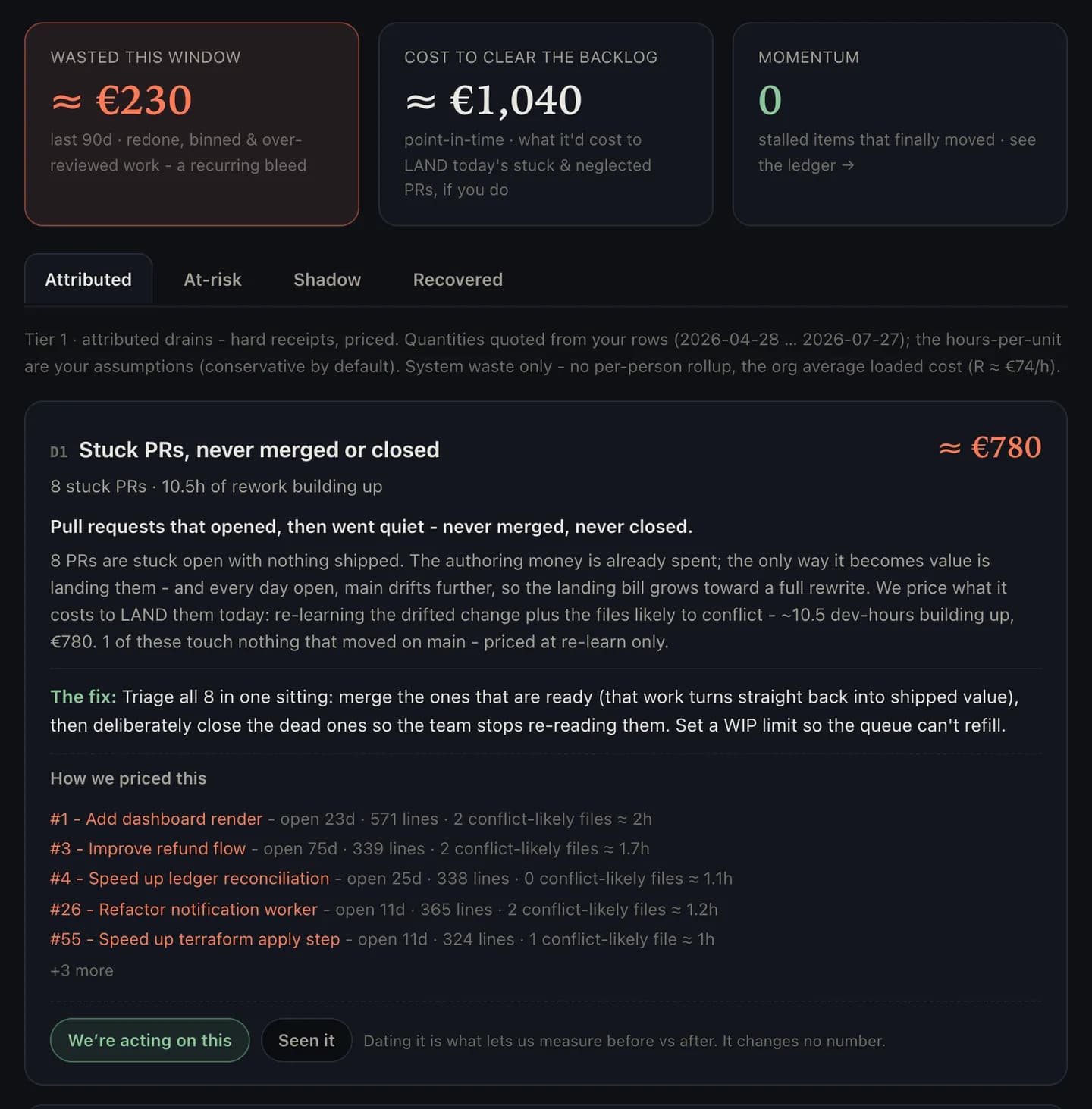
- The verdict layer. Every metric is judged against published, cited bands: good/bad/fix-this, with the receipts (the actual PRs, commits, tickets) linked on the claim. The assessment reads like a blunt fractional CTO.
- Consequences get priced. Drains are expressed in your currency (what the review queue, the dead PRs, the knowledge silos actually cost), and every prescription carries a payback estimate on the money surfaces.
- Deterministic AI attribution. Only quotable evidence counts (agent trailers, bot accounts); blind spots are disclosed instead of papered over by a threshold.
- The refusals. No firing signal and no shame board: Standing orders people only with the receipts open, thin samples labelled, exemptions honoured - and the scorecards price what losing someone would cost, never whether to keep them.
Choosing a LinearB alternative: who should pick which
| You are… | Pick |
|---|---|
| 100+ devs, multi-git estate, need SOC 2/SSO on the checklist today | LinearB |
| Sold on live peer percentiles as the core artifact | LinearB |
| Want PR automation acting on your repos, not just insight | LinearB |
| Under ~50 devs and the Enterprise floor prices you out of Jira/Slack data | Busfactor |
| Need numbers an auditor or CFO can re-run and verify | Busfactor |
| Want a diagnosis with priced fixes, not dashboards to interpret | Busfactor |
| Allergic to per-seat pricing that grows every time you hire | Busfactor |
Run the same evaluation questions against both of us, especially the reproducibility one. We wrote it knowing which answer each vendor can give.
Frequently asked
Is LinearB a good tool?
Yes, for what it is. It's a Leader in the inaugural 2026 Gartner Magic Quadrant for Developer Productivity Insight Platforms (announced May 2026), its published benchmark cohort (8.1M+ PRs across 4,800 teams) is the largest in the category, and gitStream is real, shipped workflow automation. The honest criticisms are different ones: the AI-attribution number is a tunable confidence threshold, several models in the product are undisclosed, and the features most buyers assume are standard (issue-tracker data, Slack) sit in the Enterprise tier as published in July 2026.
How does LinearB detect AI-assisted work?
Via a classifier with a confidence threshold, per their own 2026 release notes: work scoring above the threshold counts as AI-assisted. The default threshold launched at 50%, became configurable in March 2026, and was lowered to 25% in June 2026. The underlying scoring model is not disclosed in those notes. Busfactor's attribution is the opposite trade: only deterministic evidence (agent trailers, bot accounts) is counted, the blind spots are disclosed, and the number re-runs identically.
What does LinearB cost compared to Busfactor?
As of July 2026, LinearB's published pricing is per-contributor with seat minimums: Essentials at $29/contributor/month (billed annually, minimum 30 billable users) and Enterprise at $59/contributor/month (minimum 50 users), with Jira/Azure Boards, Slack/Teams, forecasting, and cost capitalization in Enterprise. Busfactor is priced per active developer with published tiers, every capability in every paid tier, so the comparison depends mostly on your headcount and which gated features you need.