Busfactor vs Swarmia in 2026: The Most Honest Rival
THE MOST HONEST RIVAL
An honest Swarmia alternative comparison: Slack loops and the free tier conceded, the default-on low-confidence AI signal examined, and who should pick which.
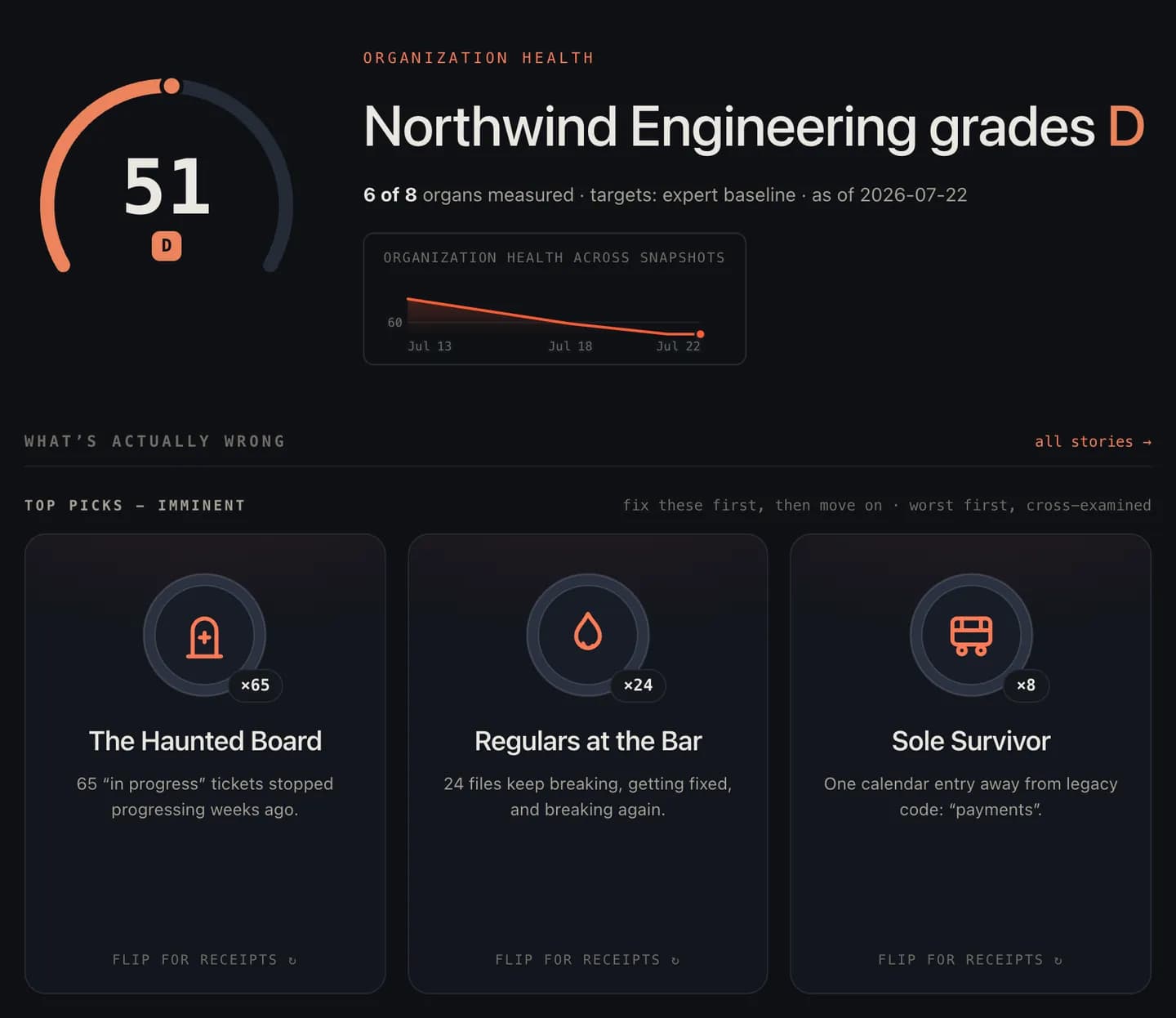
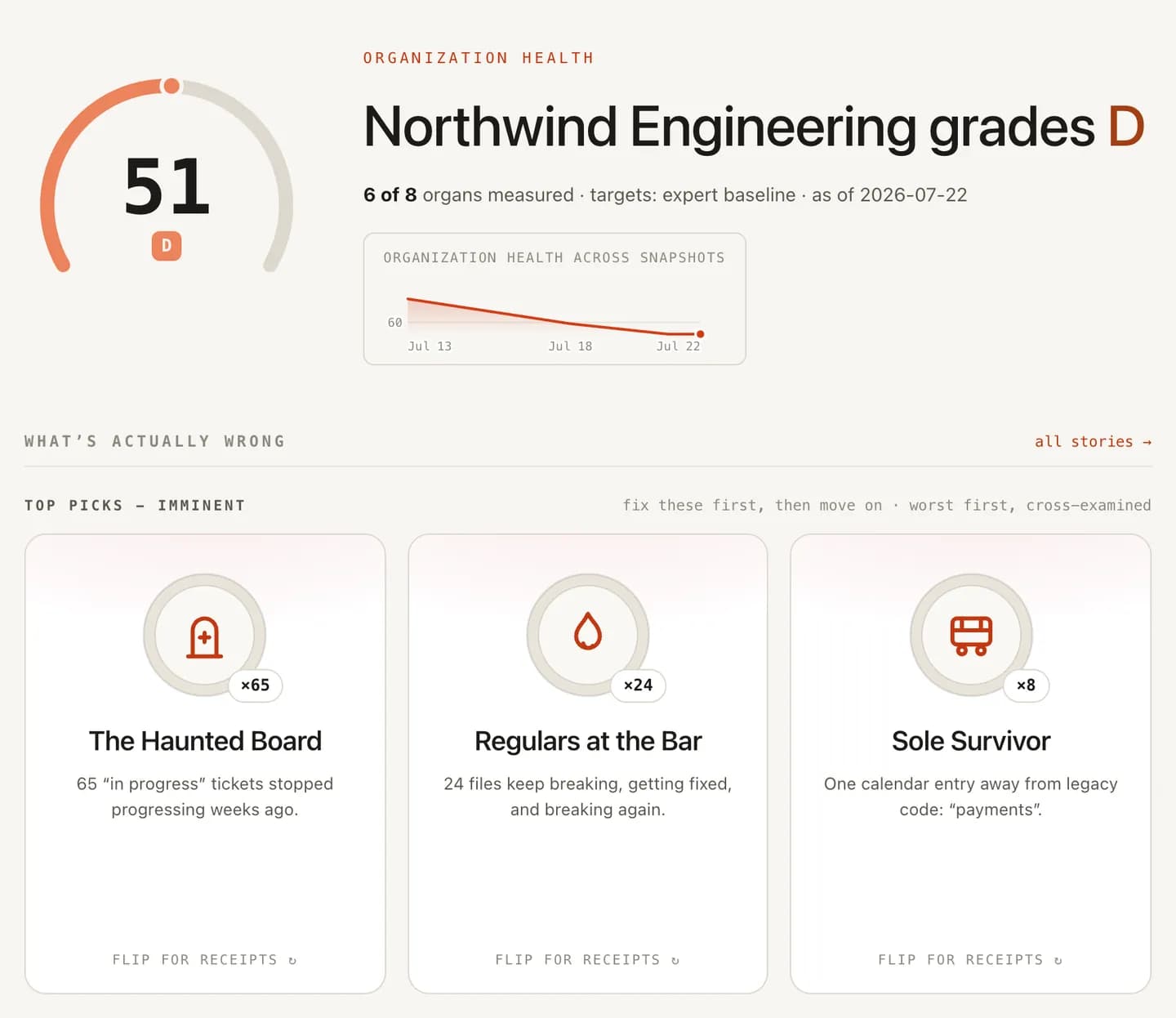
The band we grade against.
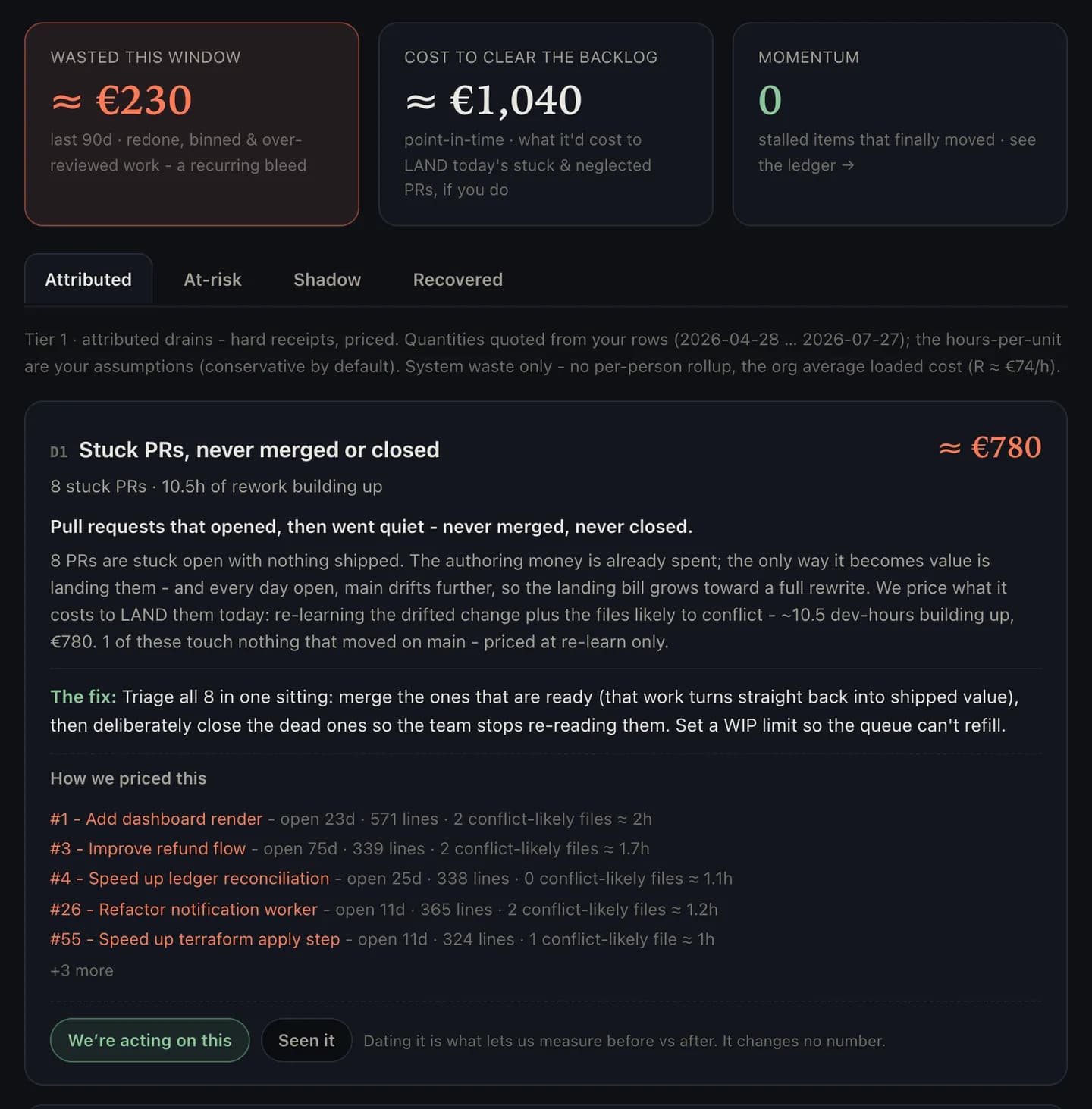
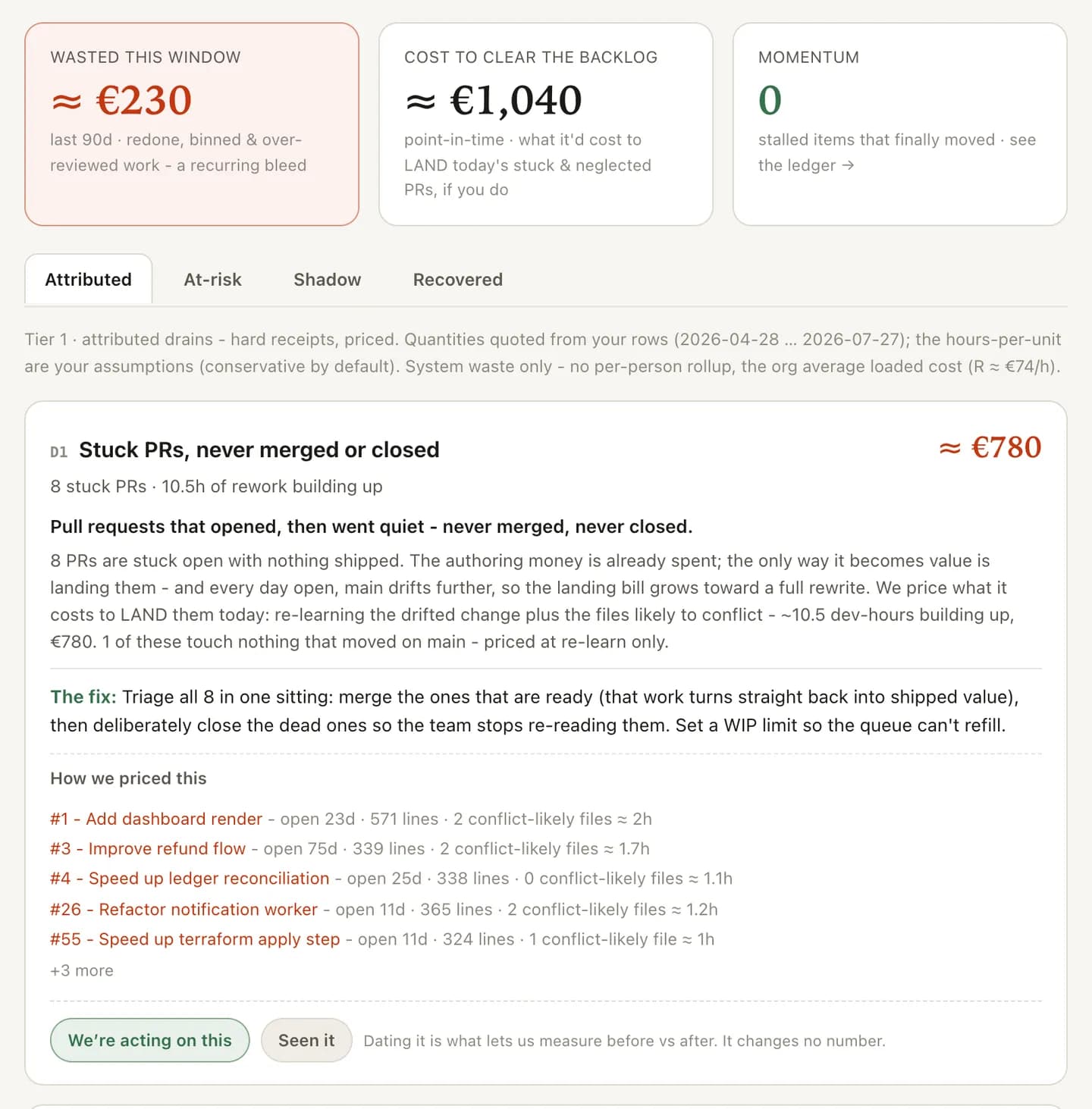
Illustrative example
TL;DR: Swarmia is the rival we respect most. Their AI-detection docs grade their own signals by confidence and admit where they overreport, their Slack feedback loop is shipped and habit-forming, and they're free for the smallest teams. If that's the shortlist you're on, good - it's an honest shortlist. The case for Busfactor as a Swarmia alternative is that even the most honest rival keeps three probabilistic layers inside load-bearing numbers, makes no reproducibility claim, and hands you charts and nudges where we hand you a graded verdict with priced consequences. Every claim below is cited to their own pages.
Most vendor comparison pages pick the weakest competitor framing and demolish it. That doesn't work on Swarmia, because Swarmia's methodology documentation is the best in the category and pretending otherwise would cost us the credibility this page runs on. So this is the harder, more useful comparison: what they genuinely do better, where the machinery actually differs, and which of us fits which team. All of it is a dated snapshot of both products as of July 2026, because this category moves monthly. (The vendor-neutral version of this exercise is the buyer's guide.)
What Swarmia genuinely does better
The Slack feedback loop. Swarmia's working agreements are a curated catalog (WIP limits, code-review velocity, cross-team collaboration) where teams set their own targets, and the enforcement loop is Slack-native: personal nudges ("unblock your teammate" when a PR waits past the agreed threshold) plus team digests. It's shipped, it's sticky, and it builds the habit in the tool your engineers already live in. Busfactor's agreements put targets and policy on one substrate and grade them weekly. But our delivery is in-app today; Slack push hasn't shipped. A shipped loop beats a planned one, and this row is theirs.
The entry price. Free up to 9 developers, per their pricing page. For the smallest teams that is simply a better deal than any paid product, ours included, and we'd rather say so than pretend the row doesn't exist.
The honesty of their own docs. Swarmia's
AI-detection documentation
lists four signals and grades each by confidence: three deterministic, high-confidence
facts (AI commit authorship, Made-with trailers, AI PR labels) and one low-confidence
telemetry heuristic they themselves flag as able to overreport. They also separate
cloud agents and review agents
into distinct modes. In a field where our
determinism audit found mostly undisclosed
classifiers, publishing your own error bars is real integrity. This is the closest
methodology to ours anywhere in the category.
Certifications and calendar-refined capitalization. Their capitalization is rule-based (you filter work by any attribute combination) with developer FTEs inferred from commit and issue activity and then refined by an HR-system integration that subtracts vacations and leave. SOC 1 and SOC 2 Type 2 sit behind it. Busfactor holds neither certification today, and we don't ingest HR calendars; if procurement needs those boxes now, that's their row.
The three models inside the numbers
With Swarmia the fork is genuinely narrow, which is exactly why it matters. Three probabilistic layers sit inside numbers a buyer will treat as facts:
- The default-on fourth signal. The 24-hour heuristic - a commit counts toward AI-assisted work if its author used an AI tool that day - is included in AI-assisted counts by default, graded low confidence, and their own docs say it "can result in overreporting." You can filter to high-confidence-only, which they note underreports. That's the same trade Busfactor made, except we made it everywhere, made it the only mode, and print the blind-spot disclosure on the surface. Their default answers "how much AI-assisted work" with an estimate; ours answers with a smaller number that re-runs byte-identically.
- An AI categorizer inside the money. Investment Balance categorizes work by user-defined rules plus AI auto-categorization, pitched as the route to "0% uncategorized work." That categorization is then multiplied by your fully-loaded engineer cost and can feed capitalization reporting. When an opaque classifier re-categorizes work, money silently moves between buckets with no provenance trail. Our allocation is rule-based against an org-configured map, and the CapEx export prints run id, engine version, ruleset version, and content hash, so the auditor can re-derive it (the accounting stakes are covered in CapEx vs OpEx). One more detail for your finance team: their capitalization page names no accounting standard.
- The assistant. Swarmia AI answers plain-language questions with summaries, tables, and next steps: an LLM layer with no quote-only guarantee claimed. Useful, and capable of misstating the number it summarizes.
And the cross-cutting fact: nothing in Swarmia's public material claims reproducibility. The test we invite on our own exports - re-run the period, diff the bytes - is not a test their material offers.
The pricing mechanics, side by side
Swarmia rebuilt this page during 2026. If you read an older comparison of ours, or anyone else's, that quotes a "Lite" tier at €20: that tier is not on their pricing page any more. Here is what Swarmia's pricing page said when we checked it on 28 July 2026, with the billing toggle on "Billed annually" (a monthly option exists and costs more):
- Free, in their words, "for companies with up to 9 developers".
- Standard: 42 € per developer per month - the bundle, "Includes all features from" all four single-feature plans below.
- Enterprise: 52 € per developer per month - "everything in Standard, plus" on-premise integrations, HR system integrations, professional services.
- Four single-feature plans you can start with instead: AI adoption & cost 4 €, Developer surveys 8 €, Software capitalization 16 € (capitalization, investment balance, initiatives, focus summary), Productivity & AI impact 22 € (AI adoption, impact and costs; "Code, issue & DORA metrics"; metrics benchmarks; working agreements).
Two things a buyer should register. First, the modules add up to 50 € and Standard is 42 €, so the bundle is priced to be the answer the moment you want more than one of them. Second, the entry point is now genuinely cheap and genuinely narrow: 4 € per developer buys AI seat and cost tracking and nothing else. The metrics most people mean when they say "engineering analytics" start at the 22 € module. Fifty developers on Standard run about €2,100/month at list, and the bill grows with every hire. Busfactor is per-developer tiers with no seat cap, published on the pricing page, with every capability in every paid tier. Below ten developers their free tier wins outright on price; past that, our rate is the lower of the two at every headcount.
A billable seat is, per their docs, "the number of unique team members added to teams in Swarmia", and we found no published seat minimum.
What Busfactor does that Swarmia doesn't
Swarmia gives you honest charts and a nudge engine. What it doesn't give you is a stance:
- A graded verdict. Every Busfactor metric is judged against published, cited bands and rolled into a quarterly report card. The assessment tells you what's fine, what's on fire, and which fire is first.
- Priced consequences. Drains are expressed in your currency on the money surfaces, and every prescription carries a payback estimate. Swarmia shows cost per epic; it doesn't tell you what the review queue is costing you or what fixing it is worth.
- Diagnosis surfaces they don't have: delivery tracing at the item grain, a review-friction taxonomy, knowledge-risk and bus-factor mapping, documentation health. Whole territories outside their metric set.
- Determinism as a guarantee. Zero models in the metric path, provenance printed on exports, byte-identical reruns.
Swarmia ships no stack-rank and no per-developer score, deliberately. We ship the per-person view they won't. Standing orders named people on delivery, review, knowledge and momentum: every position opens the pull requests that put it there, the weights sit on screen and switch off, a thin sample is labelled fuzzy rather than quietly ranked as if it were solid, anyone marked exempt from negative surfaces is out of the ordering entirely, and the same rows always produce the same order.
Decide that fork before the feature matrix. If "who is carrying this codebase" is a question you would rather nobody in your org could ask, Swarmia is the more comfortable product and this is the paragraph that saves you a demo. The rest of the difference is what sits on top of the honest data. Swarmia shows it to you and nudges. Busfactor grades it, prices it, and tells you which fix pays back first.
Choosing a Swarmia alternative in 2026: who should pick which
| You are… | Pick |
|---|---|
| Under 10 developers and paying €0 sounds like the right price | Swarmia |
| Sold on Slack-native nudges as the behavior-change engine | Swarmia |
| Need SOC 1/SOC 2 and HR-calendar-refined capitalization today | Swarmia |
| Certain no per-developer view should exist in your org, at any price | Swarmia |
| Need to know who is carrying the codebase, with the receipts on every position | Busfactor |
| Unwilling to ship an estimate-inflated AI number or an AI-categorized finance number | Busfactor |
| Want a graded verdict with priced drains and payback on fixes, not charts to interpret | Busfactor |
| Want numbers an auditor or CFO can re-run and verify to the byte | Busfactor |
| Tired of per-seat pricing that grows every time you hire | Busfactor |
Whichever way you lean, run the evaluation questions against both of us. Swarmia will answer more of them honestly than almost anyone - which is exactly why the ones they can't answer, the reproducibility ones, are the ones to ask.
Frequently asked
How does Swarmia detect AI-assisted work?
Via four signals, each with a confidence tier their own docs state: commits authored or co-authored by an AI tool, Made-with git trailers, and AI PR labels are graded high confidence, all deterministic facts, the same family Busfactor counts. The fourth signal (commits by an author who used an AI tool within the previous 24 hours, powered by provider telemetry) is graded low confidence, and their docs say it can result in overreporting. Busfactor counts only the deterministic family and discloses the resulting undercount instead of estimating over it.
What does Swarmia cost compared to Busfactor?
Swarmia restructured its plans during 2026: the old Lite tier at €20 is gone from the pricing page. Checked 28 July 2026, the page reads free 'for companies with up to 9 developers', then Standard at 42 € per developer per month billed annually and Enterprise at 52 € (adds on-premise integrations, HR system integrations, professional services). Underneath those sit four single-feature plans, all per developer per month billed annually: AI adoption & cost at 4 €, Developer surveys at 8 €, Software capitalization at 16 €, and Productivity & AI impact at 22 €, which is where 'Code, issue & DORA metrics' now lives. A billable seat is 'the number of unique team members added to teams in Swarmia'. Busfactor is priced per active developer with published tiers and every capability in every paid tier, so the comparison mostly depends on your headcount and how many of their modules you would end up buying.
Is Swarmia a good tool?
Yes, and unusually honest for the category. Their AI-detection docs grade their own signals by confidence and admit where they overreport, their capitalization is rule-based with SOC 1 and SOC 2 Type 2 behind it, and their Slack working-agreements loop is shipped and genuinely habit-forming. The fair criticisms are different ones: three probabilistic layers sit inside load-bearing numbers (the default-on 24-hour AI heuristic, the AI categorizer inside Investment Balance, and the Swarmia AI assistant), no reproducibility claim is made anywhere, and the product hands you charts and nudges rather than a graded verdict.
Receipts
- Swarmia - AI tool detection and filters (help docs)
- Swarmia - AI agent metrics (help docs)
- Swarmia - Investment Balance product page
- Swarmia - Software capitalization product page
- Swarmia - Working agreements product page
- Swarmia - Swarmia AI (help docs)
- Swarmia - Pricing (checked 28 July 2026)
- Swarmia docs - Pricing & plans (billable-seat definition, free-plan limit)