Busfactor vs Port (2026): Scorecards You Define, or Ours
SCORECARDS YOU DEFINE, OR OURS
A fair Port alternative guide: the self-serve IDP and free tier conceded, why DORA rollups aren't a verdict, and how our exports could feed its catalog.
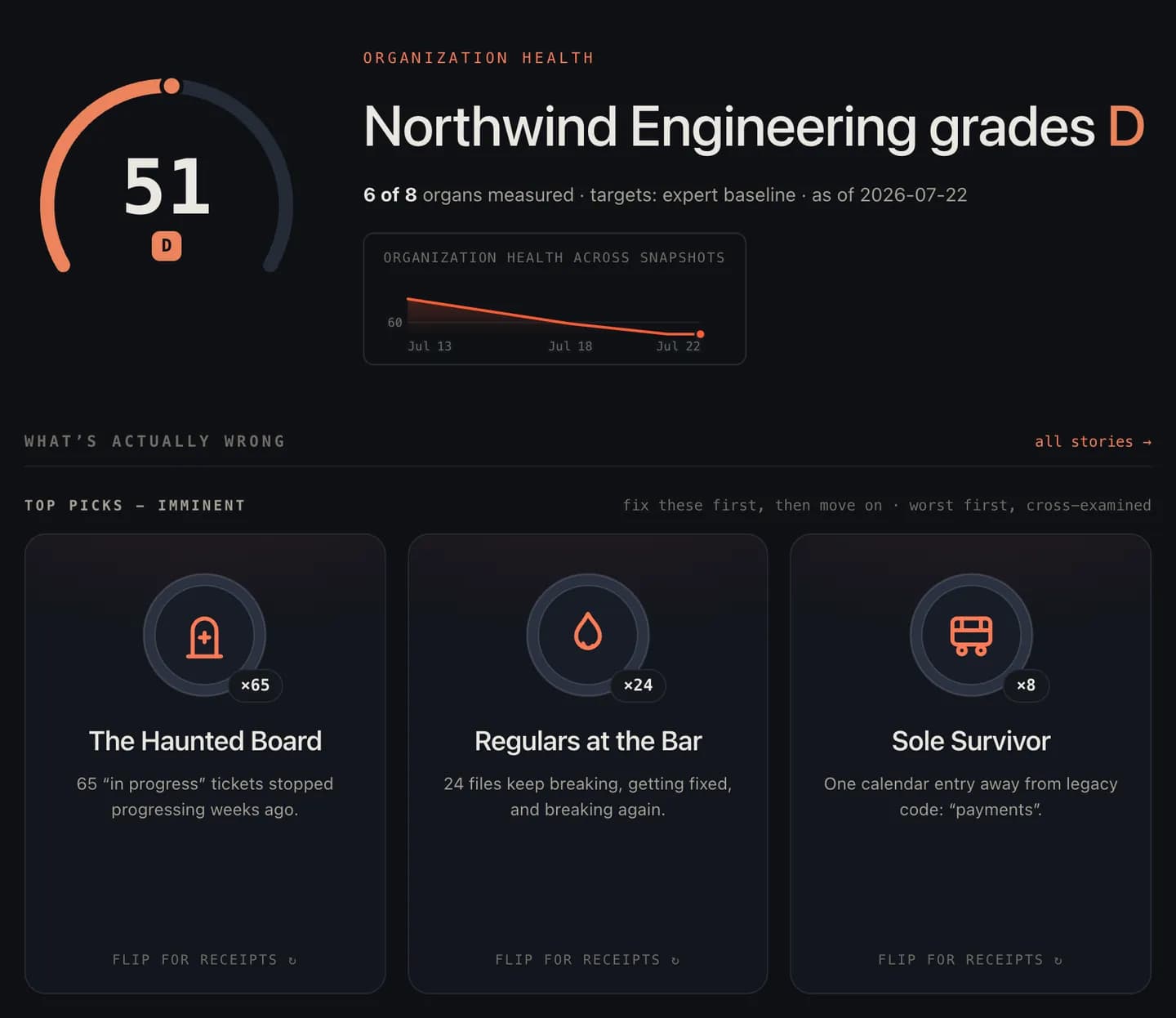
The band we grade against.
Illustrative example
TL;DR: Port is an internal developer portal, not an engineering-intelligence product. This page exists because its DORA module and "Engineering Intelligence" labeling make buyers compare across categories. The concessions are easy: Port's self-serve motion is genuinely good, the free tier for up to 15 seats undercuts everyone, and the catalog/scorecards/actions machinery is a real platform product. The distinction is just as easy: Port's intelligence layer is a DORA rollup without a stance, where scorecards measure what you define and agents act on what you configure. Busfactor is the stance: a judged, receipts-linked, priced diagnosis of the org. And uniquely in this comparison series, the two could feed each other.
Port pitches "Build your Agentic SDLC": a software catalog with a Context Lake underneath, self-service actions, scorecards, and BYO-LLM AI agents on top. It's the self-serve counterweight to enterprise IDPs (that's the Cortex comparison, which covers the same category line from the quote-motion side). What earns Port its own page is its Engineering Intelligence module, which computes DORA per service, rolls it up to team and org, and ties it to catalog entities - close enough to SEI vocabulary that a confused shortlist is understandable. Snapshot as of July 2026, every claim linked; re-verify before buying.
Whichever category you land in, the delivery metrics that actually matter are the fundamentals underneath both.
What Port genuinely does well
The PLG motion. A free tier with the full platform (catalog, scorecards, actions, workflows, AI agents with usage limits) for up to 15 seats is the most generous entry in the portal category, and self-serve tiers at $30 and $40/seat/month mean a mid-size platform team can adopt without a sales cycle. We respect this motion because it's ours too, in a different category.
Catalog plus standards machinery, self-serve. The Software Catalog and Context Lake give you the service inventory; scorecards let you define maturity and reliability standards with surveys, automations, and alerts to actively improve them; the scaffolder and workflow orchestrator enforce policy on the paved road. Busfactor builds none of this, on purpose. It's a platform team's product, and a good one.
The aggregation posture. Port's intelligence module is explicitly built to ingest metrics from other vendors and attach them to catalog entities. That's an honest architectural admission: Port wants to be where metrics are displayed, not the authority on what they mean. It makes Port more channel than competitor from where we sit.
The category line: a rollup is not a diagnosis
Port's DORA surface will tell you deployment frequency per service, rolled up per team and org. What it structurally cannot tell you is what a fractional CTO would: whether that number is good, why it's what it is, what it costs you, and what to fix first. No missing feature there; that's the category boundary. An IDP's intelligence module reports; standards live in scorecards you author; action lives in agents you configure with your LLM.
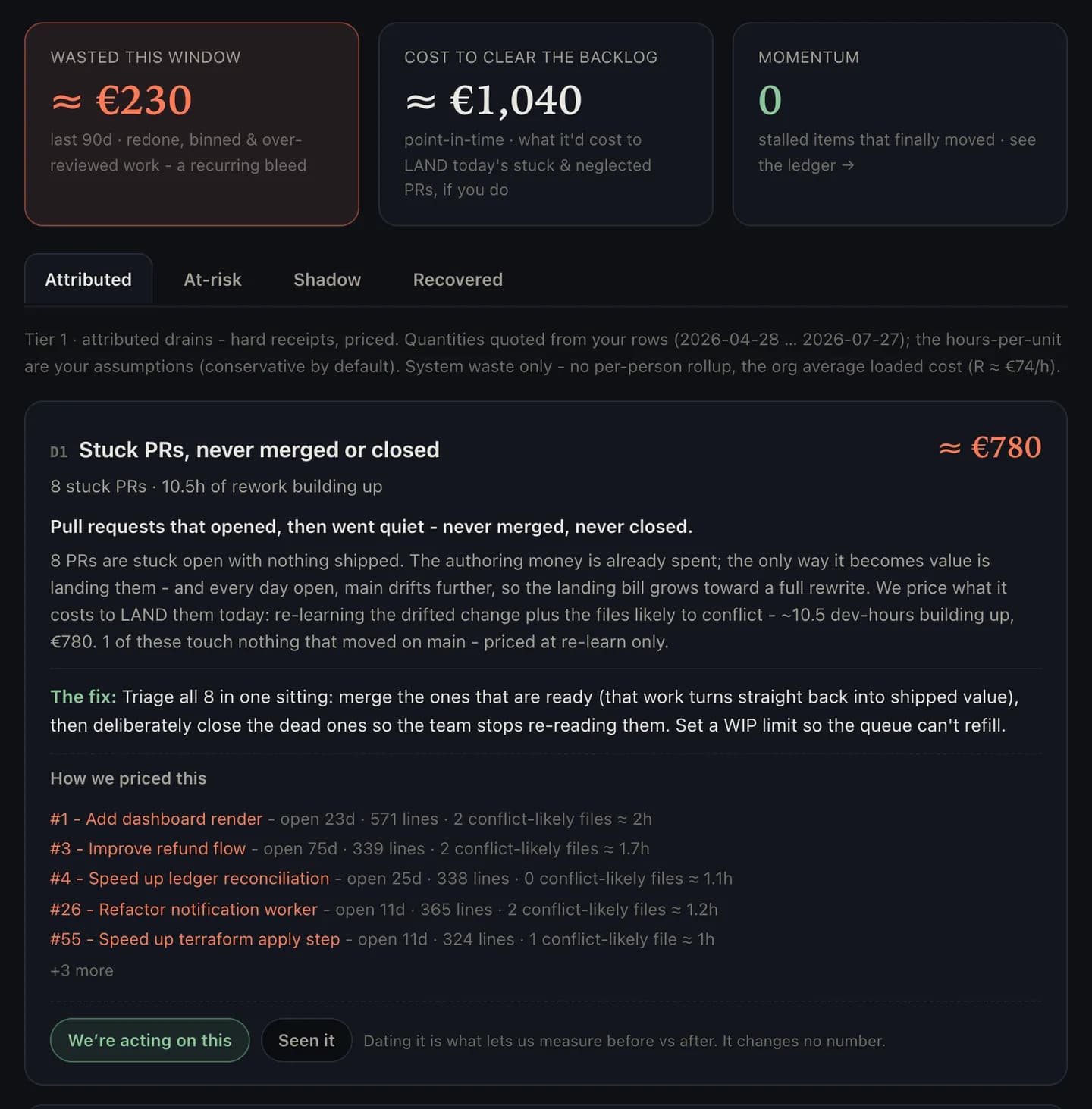
Busfactor starts where the rollup stops. The assessment judges the org's stats against published, cited bands and takes a stance with receipts linked on every claim. The money surfaces price the drains in your currency and attach payback estimates to fixes. Knowledge-risk mapping finds the silos and orphaned areas no catalog field captures. And the whole thing re-runs byte-identically - same rows in, same bytes out, provenance printed - which matters even more when your numbers are going to be displayed in someone else's portal.
Which brings up the genuinely unusual row in this comparison: composition. Port ingests other vendors' metrics; Busfactor ships a deterministic export API, byte-identical CSV/JSON with the content hash printed. If your platform team runs Port and your CTO runs Busfactor, the judged numbers can live on Port catalog pages with their provenance intact. We're not aware of another pairing in either category where "use both" is this literal.
Pricing, side by side
As of July 2026, from Port's pricing page: Free ($0, up to 15 seats, full platform, AI-agent usage limits); Basic ($30/seat/month, up to 50 seats, unlimited agent usage with your own LLM); Standard ($40/seat/month, up to 200 seats, SSO); Enterprise custom (SCIM, Private Link, IP allowlist, 99.9% SLA). Busfactor's per-developer tiers are on the pricing page. Note that their seat tiers cap (15, 50, 200) while ours do not. But honestly, price shouldn't decide this one: the products answer different questions, and the real cost of an IDP is the platform-team quarters spent modeling your org into it, not the seat fee.
Who should pick which
| You are… | Pick |
|---|---|
| A platform team under 15 people wanting a catalog today, free | Port |
| Standardizing scaffolding, ownership, and golden paths self-serve | Port |
| Wiring BYO-LLM agents into catalog-governed workflows | Port |
| A CTO who wants a judged diagnosis nobody had to configure | Busfactor |
| Need drains priced and fixes with payback, re-runnable for an auditor | Busfactor |
| Want DORA context with a stance, not a rollup beside a catalog entry | Busfactor |
| A scale-up with a platform team and a CTO who wants straight answers | Both - they compose |
For the actual SEI category - the tools Port's module superficially resembles - start with the buyer's guide and bring the evaluation questions to every demo. And if your cross-category confusion is workflow-shaped instead of portal-shaped, the Graphite and Aviator pages draw the same honest line for merge-queue tools.
Frequently asked
Is Port an engineering analytics (SEI) tool?
Not primarily. Port is an internal developer portal: a software catalog with a Context Lake, self-service actions and scaffolding, scorecards against standards you define, and BYO-LLM AI agents. It ships an Engineering Intelligence module (DORA metrics rolled up per service, team, and org, tied to catalog entities), and it can even ingest metrics from dedicated SEI vendors. That makes it a metrics aggregation surface, not a diagnosis: the rollups have no verdict, no priced consequence, and no receipts grammar. Different category, different job.
How much does Port cost?
As of July 2026, Port's published pricing: Free at $0 for up to 15 seats (full platform including Scorecards and AI agents with usage limits), Basic at $30/seat/month (up to 50 seats, unlimited AI-agent usage with your own LLM), Standard at $40/seat/month (up to 200 seats, SSO), and Enterprise custom (SCIM, Private Link, IP allowlist, 99.9 percent SLA). All tiers include the catalog, actions, scorecards, and workflows. Busfactor is priced per active developer with published tiers, but the honest note is that the products do different jobs, so price is rarely the deciding row.
Do Port and Busfactor overlap or work together?
The overlap is one module: Port's DORA rollups touch the same data family as an SEI tool. Everything else is complementary: Port catalogs and standardizes; Busfactor diagnoses and prices. They can literally compose: Port's engineering-intelligence surface is built to ingest metrics from other vendors, and Busfactor ships a deterministic export API (byte-identical CSV/JSON with a printed content hash), so Busfactor numbers can live inside Port catalog pages with their provenance intact.