Busfactor vs Oobeya (2026): Dashboards or a Verdict
DASHBOARDS OR A VERDICT
An honest Oobeya alternative comparison: their on-prem posture and integration breadth conceded, our receipts and priced verdicts, and who should buy which.
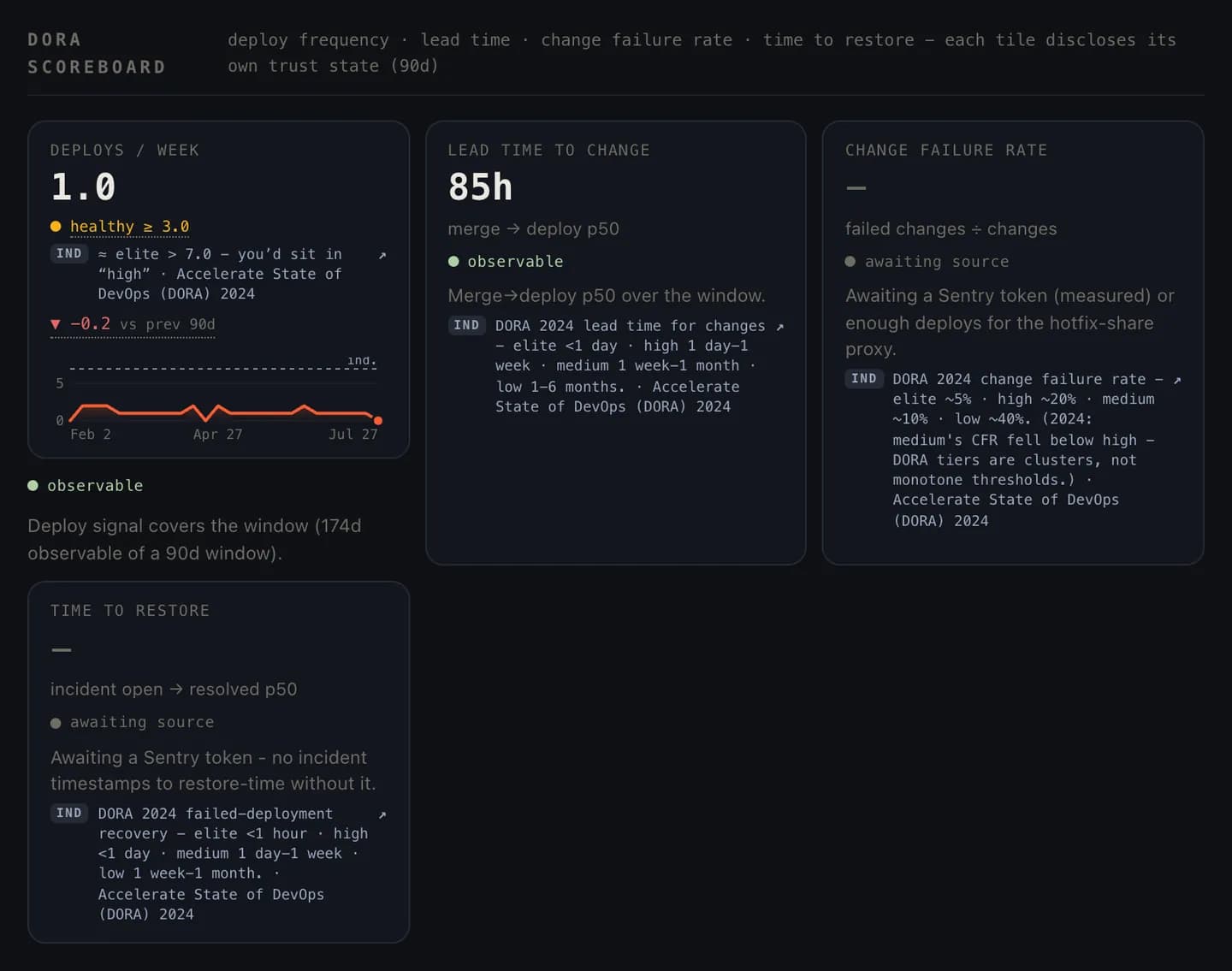
The band we grade against.
Illustrative example
TL;DR: Oobeya is a broad enterprise dashboard suite for "Engineering Visibility & Control in the Age of AI-Assisted Development": DORA plus delivery, quality, and AI views, 30+ integrations including SonarQube, ISO 27001 certified with on-prem available. That's real enterprise posture, conceded plainly. The honest case for Busfactor as an Oobeya alternative is the layer Oobeya doesn't ship: a judged verdict with receipts on every claim, consequences priced in your currency, numbers with zero LLMs inside that re-run byte-identically. Oobeya's AI chat narrates dashboards instead, and its KPI gamification hands out targets without the guardrails we consider load-bearing. Snapshot as of July 2026; re-verify before buying.
Oobeya sits in the crowded middle of the category: more enterprise-ready than the budget tools, less famous than the majors, and, like most of the field, now wrapped in an AI narrator. This page concedes what's real and then makes one argument, the same one we make against the whole LLM-narrator tier. (Category-wide checklist: the buyer's guide.)
What Oobeya genuinely does better
Integration breadth, including code quality. Thirty-plus integrations across Git providers, Jira, Azure DevOps, CI/CD - and SonarQube, which matters: static code-quality signal is a data source Busfactor doesn't ingest today. Oobeya also claims scale to "thousands of repositories." Busfactor is GitHub-first while our multi-provider work lands, so a mixed-estate enterprise can genuinely connect more of its stack to Oobeya today.
Security posture. ISO 27001 certified, SOC 2 Type II pending, GDPR alignment, and on-prem deployment available. Busfactor doesn't hold those certifications yet, and we won't bluff past a procurement gate that requires them now. That row is theirs.
An IDE-level AI signal. Oobeya's AI Impact Measurement includes an IDE plugin capturing "AI-assisted code origin signals", a client-side telemetry route to AI attribution that Busfactor deliberately doesn't take (we measure artifacts in the repo, not editors on the laptop). The mechanics aren't disclosed, which matters below, but the ambition to attribute at the point of authorship is real engineering.
Review analytics and benchmarks exist. Code review bottleneck and wait-time analytics, plus Engineering Benchmarks that translate maturity into a shared operating language. One honest note cutting both ways: Oobeya's benchmarks are maturity bands rather than a live peer cohort, and Busfactor's published bands are cited reference points rather than peer percentiles. Neither of us owns the live-cohort row; LinearB does (see Busfactor vs LinearB).
A narrator is not a verdict
Oobeya's intelligence layer is AI Chat & Insights: natural-language questions over your data, with AI-generated executive summaries. That's an LLM in the interpretation loop, and an LLM that summarizes can also misstate, because generation is what it does. There is no quote-only guarantee claimed, no determinism claim anywhere in the product's public material, and no reproducibility test a buyer can run. Oobeya didn't invent this pattern; it's the category's default now. It is still the pattern (the determinism audit walks the whole field).
Busfactor's architecture makes the opposite promise checkable: zero LLMs in the metric path, numbers quoted, never generated, judged against published cited bands, receipts (the actual PRs, commits, tickets) linked on every claim in the assessment, and provenance - run id, engine version, ruleset version, content hash - printed on the export so re-running last quarter produces the same bytes. On top of that sits what no dashboard suite ships: consequences priced in your currency with a payback estimate per fix on the money surfaces, and a quarterly graded report card.
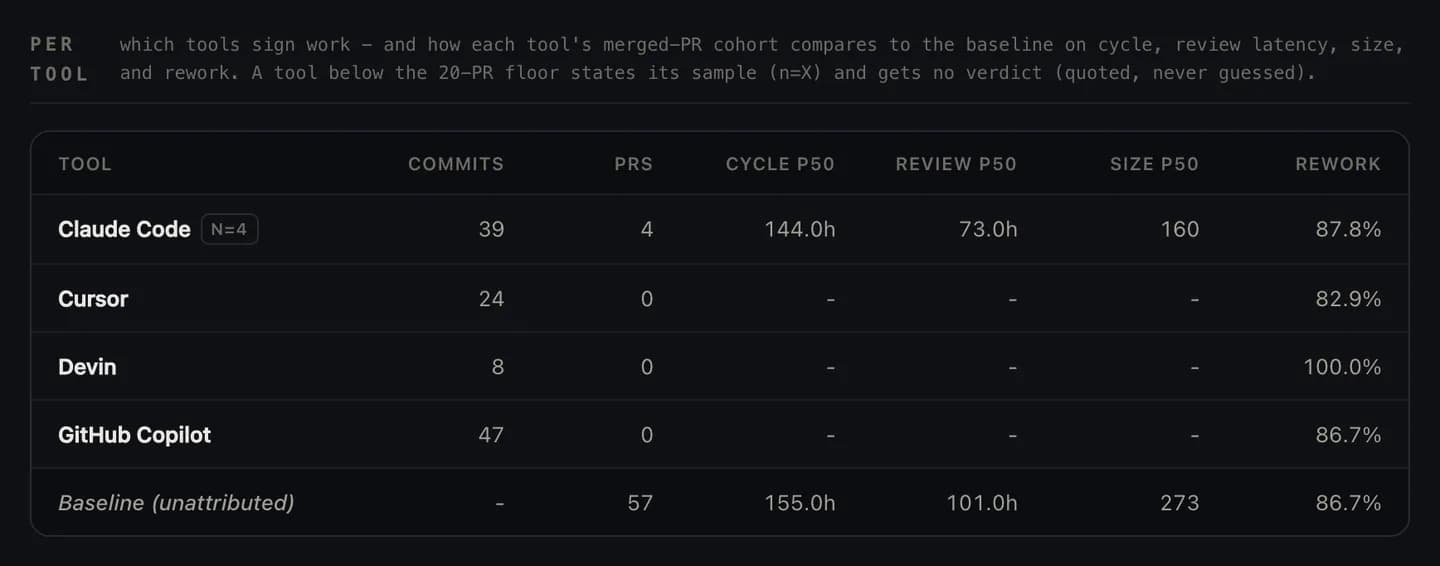
The same disclosure gap runs through the AI story: an IDE plugin capturing undisclosed "origin signals" produces a number you have to take on faith. Our attribution counts only evidence that signs its work (agent trailers, bot accounts) and prints its blind spots (the method, step by step: how to measure AI adoption).
Gamified targets, without the guardrails
Oobeya ships a gamification module: KPI targets turned into team goals. We'd flag this even if we weren't a competitor: metric targets without refusal guardrails are a Goodhart machine. The moment a number becomes a goal, people optimize the number, and no refusal guardrails are documented in Oobeya's public material (no stated line against individual scoring or ranked leaderboards either way). Busfactor's position is structural: no per-developer composite scores, no stack ranks, no firing signals - refusals that are product architecture, not settings - with retention-framed scorecards as the deliberate alternative. To be fair, Oobeya markets team-level mechanics rather than a stack-rank; the concern is what an undisciplined buyer can do with targets, and which vendor's design makes that misuse hard.
Pricing. Not published as of July 2026: Starter, Enterprise, and Enterprise AI tiers on custom quotes, plus AWS and Azure marketplace listings. Busfactor's per-developer tiers are on the pricing page. We won't estimate numbers a vendor doesn't print.
Choosing an Oobeya alternative: who should pick which
| You are… | Pick |
|---|---|
| An enterprise needing ISO 27001/on-prem and a mixed git + SonarQube estate | Oobeya |
| Wanting one broad visibility suite with an AI chat layer on top | Oobeya |
| Sold on IDE-level AI telemetry despite undisclosed mechanics | Oobeya |
| Needing numbers with zero LLMs inside, re-runnable byte-for-byte | Busfactor |
| Wanting a graded verdict with receipts and priced fixes, not chart homework | Busfactor |
| Wary of KPI gamification and per-person misuse by design | Busfactor |
Take the evaluation questions to both demos and ask each vendor to re-run last quarter live. The rest of our July 2026 comparison set: Busfactor vs Allstacks, Busfactor vs Hatica, and Busfactor vs Code Climate.
Frequently asked
What does Oobeya do?
Oobeya is a unified engineering-visibility suite for the AI era: DORA metrics with delivery and quality context, AI Impact Measurement comparing Copilot/Cursor/Claude adoption against efficiency and cycle metrics, code review analytics, engineering benchmarks framed as maturity levels, a gamification module for KPI targets, and an AI chat layer producing executive summaries. It ships 30+ integrations including Git providers, Jira, Azure DevOps, CI/CD, and SonarQube, scales to thousands of repositories, holds ISO 27001 certification with SOC 2 Type II pending, and offers on-prem deployment. It's a genuinely broad enterprise dashboard suite.
How does Oobeya measure AI impact?
Two routes, per their site as of July 2026: correlating AI-tool adoption with efficiency, quality, cycle time, and DORA outcomes; and an IDE plugin capturing 'AI-assisted code origin signals', client-side telemetry whose mechanics are not disclosed. Busfactor takes the narrow, checkable route instead: only deterministic evidence (agent trailers, bot accounts) counts as AI-attributed, the blind spots are disclosed on the surface, and the number re-runs byte-identically. Their route sees more but can't be checked; ours counts less and every count can be.
How much does Oobeya cost?
Oobeya does not publish price figures as of July 2026: the pricing page lists Starter, Enterprise, and Enterprise AI tiers on custom quotes, with availability through the AWS and Azure marketplaces. Per our own rules we won't estimate undisclosed prices. Busfactor publishes per-developer tiers on its pricing page, with every capability in every paid tier.