Is Your Engineering Team Overloaded? Signs in the Data
OVERLOAD HIDES IN BUSY
Hover or focus to flip ↻Overload hides behind busyness. The signs: WIP above headcount, growing review queues, after-hours creep, maintenance eating the week - and how to confirm it.
TL;DR: Overloaded teams don't look idle - they look busy, which is why overload hides so well. The tells are systemic: work-in-progress far above headcount, review queues quietly lengthening, planned work losing every fight with interrupts, after-hours activity creeping across multiple people, maintenance eating the calendar. Confirm it with four trend lines, and fix it by cutting WIP before asking for headcount. Treat it seriously: sustained team overload is the assembly line that manufactures burnout one engineer at a time.
"The team feels maxed out" is one of those sentences that gets nodded at and ignored, because it arrives without evidence and everybody feels maxed out sometimes. This article is about replacing the feeling with receipts, in both directions. Sometimes the data says you're right and arms you for the capacity conversation. Sometimes it says the team isn't over capacity, it's drowning in self-inflicted WIP. Better news, actually: that one's free to fix.
Signs your engineering team is overloaded
1. WIP far above headcount. Six engineers, nineteen in-flight items. Everything moves a little each week; nothing finishes. High WIP is both a symptom of overload and an amplifier of it: context switching taxes every item. The Parnin & Rugaber research on 10,000+ programming sessions found only about 10 percent of interrupted sessions resume actual editing within a minute, and roughly 30 percent take over half an hour. Every additional parallel stream buys that tax again.
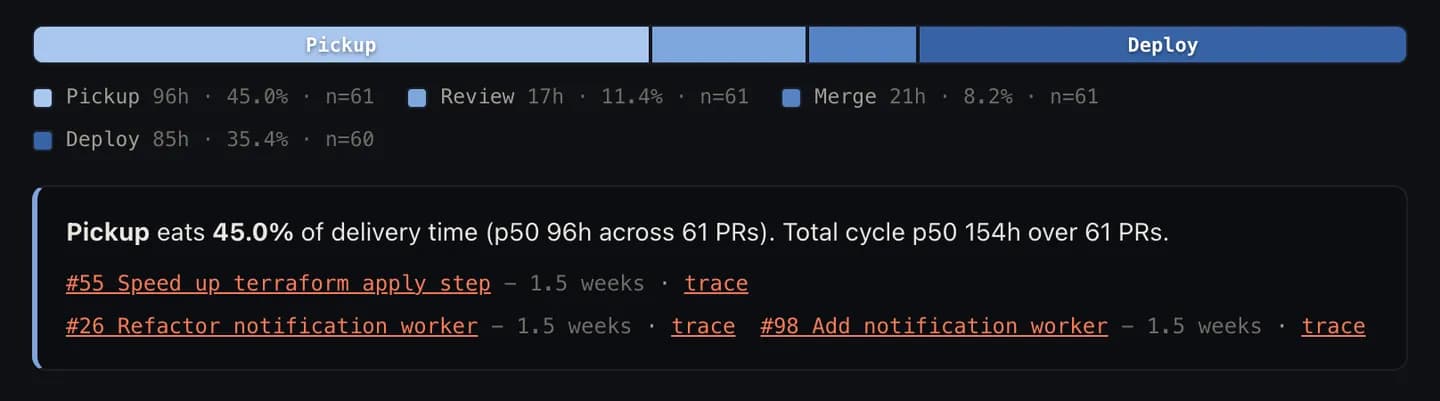
2. Review queues drifting longer. PR pickup time is a sensitive load gauge, because review is the first duty people silently drop when saturated. Against LinearB's benchmarks across 8.1M+ PRs, elite pickup is under an hour and the worst band is beyond sixteen; the absolute number matters less than the trend - a queue that lengthens month over month is a team quietly running out of slack.
3. Interrupts beat plans, every sprint. The roadmap item slips again because production, support, and "quick asks" ate the week. If the retro keeps saying "we planned X, urgent work happened," you're not bad at estimating. You're planning capacity you don't have.
4. Maintenance eats the calendar. In Stripe's Developer Coefficient survey of 1,000+ developers, respondents self-reported an average 41.1-hour workweek with 17.3 hours going to maintenance: debugging, bad code, refactoring. Self-reported figures, but directionally damning: if keeping the lights on owns the calendar, the "roadmap capacity" you're loading the team against doesn't exist.
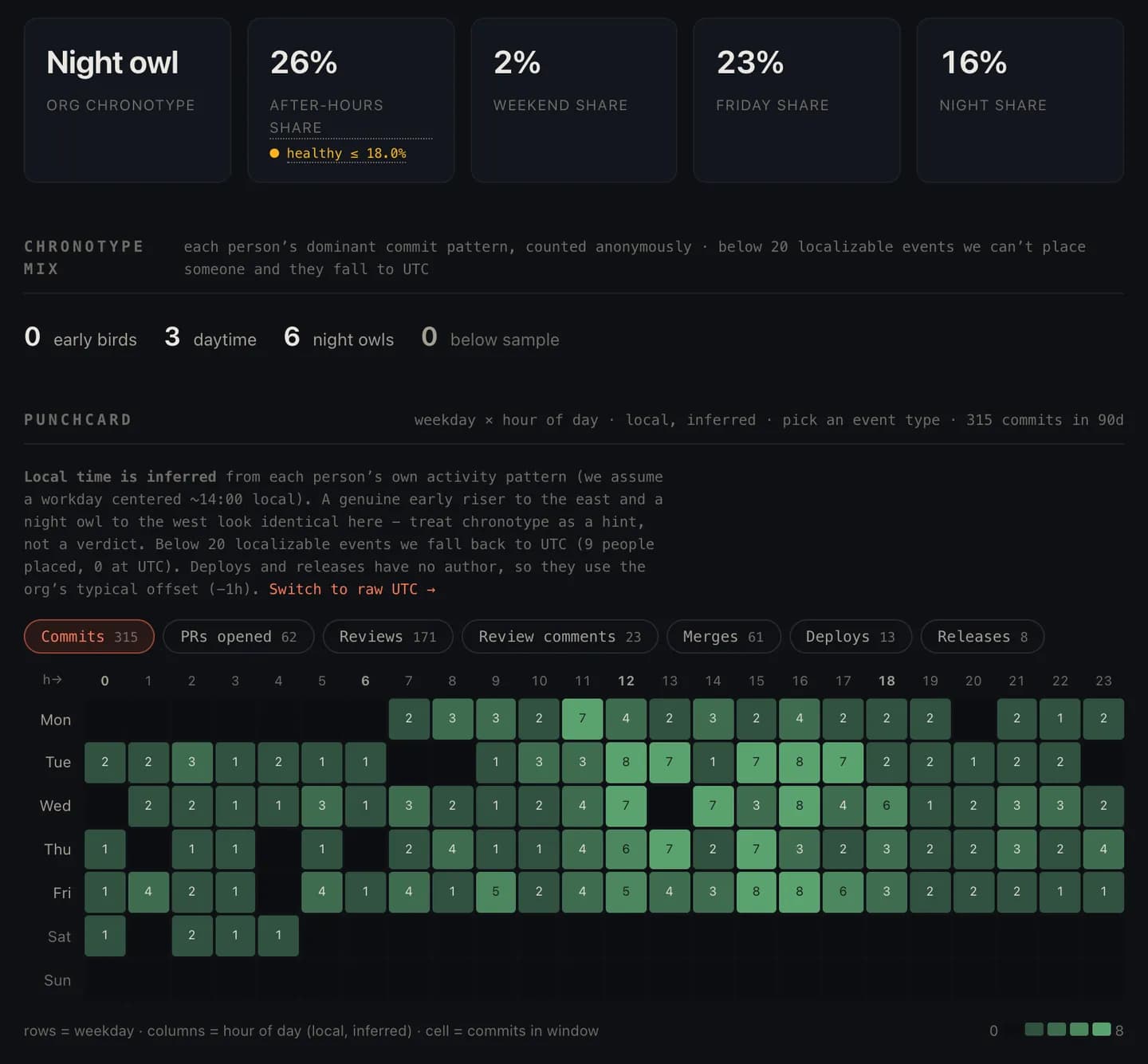
5. After-hours creep - plural. One night owl is a preference. Evenings and weekends lighting up across several people, trending upward, is a team paying for daytime overload with personal time. This is the system-level view of what burnout warning signs describe for individuals, and it's the earliest cheap moment to intervene.
6. Load concentrating on a few shoulders. The same two names on every review, every incident, every "quick question." Review load and glue work concentration mean the team's overload is being absorbed by its most capable people - the ones most expensive to lose.
7. The small stuff dies. Tests get skipped "for now," docs rot, refactors are perpetually deferred. Slack is where quality work lives; overload eats slack first, and the technical debt bill arrives with interest.
Overloaded, slow, or understaffed?
Three different diagnoses that get one lazy label. Slow is an output complaint. If that's the accusation on the table, start with why the team feels slow, because queues and dependencies can make an under-loaded team crawl. Overloaded means demand exceeds capacity as currently run: the signs above. Understaffed means demand exceeds capacity even after the system is clean: WIP bounded, queues fast, interrupts contained, and there's still twice the committed work the team can finish. You earn the right to claim understaffing by eliminating the first two explanations, which is exactly what makes the headcount case credible when you finally make it.
And before anyone reaches for the fourth label - "maybe some people aren't pulling their weight" - read why the data can't support that conclusion. A team-wide slowdown is a system fact; turning it into individual suspicion is how overloaded teams lose their best people twice.
How to confirm it: four trend lines
Overload is a claim about trend, so measure trends, not snapshots. Four lines, watched over 8-12 weeks, all available from tools you already have:
- WIP per engineer: started-but-unfinished items divided by team size.
- Review pickup time: the wait before first review, p50 and p75.
- Interrupt share: the fraction of completed work each week that was unplanned. Imperfect labeling is fine; the trend still tells the truth.
- After-hours footprint: how much activity lands outside working hours, across the team, trending.
All four are system measures. The moment any of them becomes a per-person score you've built the surveillance version, which destroys the trust you need for the fix to work.
The fix, in order of cost
- Make invisible work visible. Inventory what actually consumes the team: review load, on-call, support, mentoring, glue. Overload is often just uncounted work.
- Cut WIP - stop starting, start finishing. WIP limits are the cheapest capacity intervention that exists; finish rate rises without hiring anyone.
- Fix the slowest queue. Usually code review; every hour of queue time is paid by every item that passes through it.
- Bound the interrupts. A rotation absorbs them so the rest of the team plans real capacity: one person's bad week instead of everyone's mediocre one.
- Then, if the lines still say over-capacity: the headcount case, with receipts. Twelve weeks of WIP, queue, interrupt, and after-hours trends is a case a CFO can't wave away as "everyone says they're busy." What you're protecting is bigger than the roadmap: sustained overload concentrates on your best people first, and the prevention playbook starts with exactly this rebalancing.
Where Busfactor fits
This is the diagnosis Busfactor is built for, because every line above is a system property: WIP and flow trends, review-queue drift, load concentration by area and by role, after-hours rhythm across the team, with receipts linked to the actual PRs and queues, framed as capacity findings, never people findings. It will tell you "review load is concentrating on two people and pickup time doubled since May." It will not tell you who to blame, because that's not a data question. The teams that fix overload are the ones that never let it become one.
Frequently asked
How do you know if an engineering team is overloaded?
Look for system-level signs rather than individual complaints: work-in-progress well above headcount, review pickup times drifting longer, planned work repeatedly displaced by urgent interrupts, after-hours and weekend activity creeping up across several people at once, and maintenance quietly eating the majority of the week. Any one sign is ambiguous; several trending together over weeks is a capacity problem, not a motivation problem.
Is my team slow or overloaded?
Slow is an output observation; overloaded is an input diagnosis - and overload is the most common cause of slow. The test: count started-but-unfinished work. A team with far more open items than people isn't slow at working, it's fast at starting; everything moves a little and nothing finishes. If WIP is modest and things still crawl, look at queues and dependencies instead.
Does an overloaded team need more engineers?
Sometimes - but headcount is the most expensive fix and often the wrong first one. Adding people to a team drowning in WIP adds coordination cost and onboarding load before it adds capacity. First cut work-in-progress, fix the slowest queues, and make interrupt work visible and bounded. If the team is still over capacity when the system is clean, then you have an honest headcount case - with receipts.
What should a manager do first when the team is overloaded?
Make the invisible work visible, then cut work-in-progress. List everything actually consuming the team - including review load, support rotations, and glue work that never appears on the board - and stop starting new work until the finish rate catches up. It's the cheapest intervention with the fastest visible effect, and it produces the evidence you need for harder conversations about scope or headcount.