Your Acquirer Will Find Your Bus Factor Before You Do
THEY'LL FIND IT FIRST
Diligence teams read git history and price knowledge concentration into deals. How to audit your own key-person risk before a buyer's analyst does.
The band we grade against.
Illustrative example
TL;DR: If a raise, acquisition, or serious partnership is anywhere in your future, a stranger will eventually clone your repositories and compute how concentrated your engineering knowledge is. The estimation method is public research; the git history it reads is one you can't retroactively edit. Every finding they'd write, you can find first, months earlier, while it's still fixable instead of priceable. Below: what they'll compute, and how to have already read your own report.
Somewhere in your company's future there's a data room, and in it, an analyst you've never met with read access to everything your team has ever merged. They will not be reading your architecture diagram. They'll be reading the diary your org has been keeping for years without meaning to: who actually built each system, who reviews it, and how many of those names appear exactly once.
If you haven't computed your own bus factor, the title of this article is just literally true: the first person to measure your key-person risk will be someone pricing it against you.
Why bus factor shows up in technical due diligence
What a buyer actually purchases is the ability to keep changing the code. Technical due diligence exists to price the risk that this ability doesn't transfer, and nothing threatens transferability like knowledge that lives in one head. A codebase with a bus factor of one is a retention negotiation wearing an asset costume.
That's why key-person risk gets its own line in diligence reports, next to debt and security. The buyer's question is brutally simple: if these two people decline our offer, what did we just buy?
What a diligence analyst can compute from your git history
More than most founders expect, with public methods:
- Truck factor, formally. Avelino et al. (2016) published the method a decade ago: weight authorship per file, greedily remove authors, count how many departures orphan the system. Across the 133 popular GitHub systems they studied, 34% had a truck factor of exactly 1, and around 65% sat at 2 or lower. Your analyst has read this paper. The uncomfortable base rate says the finding is more likely against you than for you.
- Ownership health, both directions. Bird et al.'s ownership research (Windows Vista/7) found more low-expertise contributors correlates with more faults and failures, while strong top-owner ownership correlates with fewer. So diligence reads concentration two ways: too diffuse looks like quality risk, too concentrated looks like continuity risk. "One clear owner plus a capable second" is the profile that reads well, which is exactly the shape succession planning builds.
- The story-versus-repo gap. If the pitch says "strong team ownership culture" and the history shows one name on 70 files and every review rubber-stamped by the same person, the contradiction itself becomes the finding. Git history doesn't negotiate.
What they can't compute - pager lore, vendor relationships, the undocumented deploy - they'll extract in interviews. The 2024 Stack Overflow survey's finding that 45.2% of developers say knowledge silos block ideas from crossing the org is the kind of ambient truth a good interviewer surfaces in an afternoon.
Run the buyer's analysis on yourself first
- Compute your own truck factor with the honest afternoon method in how to calculate bus factor. Per area, not just per repo; the repo number hides the orphans.
- Inventory the bus-factor-1 areas and rank by blast radius. Which orphaned area stalls revenue? Which is actively changing?
- Spread the worst two, starting now. Review rotation plus deliberately routing the next tickets to a second person. The mechanics are in how to reduce bus factor, and the ninety-minute drill is the fastest way to find the walls git can't show you. Knowledge transfer has a floor on how fast it goes; that floor is why this starts months before any process does.
- Write the mitigation memo. A known, mitigated concentration reads as competence; a discovered, denied one reads as a discount. One page per red area: the risk, the second person, the trajectory.
- Protect the people the analysis names. This is the part that matters most, and not only for the deal: the engineers your map flags are your most load-bearing people, not suspects to manage. Recognition, real vacations, and retention conversations are dramatically cheaper before a diligence report makes those names leverage. A concentration map is a protect list - if any process turns it into a cut list, the analysis has been read upside down.
The report you'd rather write yourself
Everything above works as a one-time audit. Its weakness is the calendar: ownership shifts with every merge, and the audit you ran in March is fiction by August - possibly the exact month the term sheet arrives.
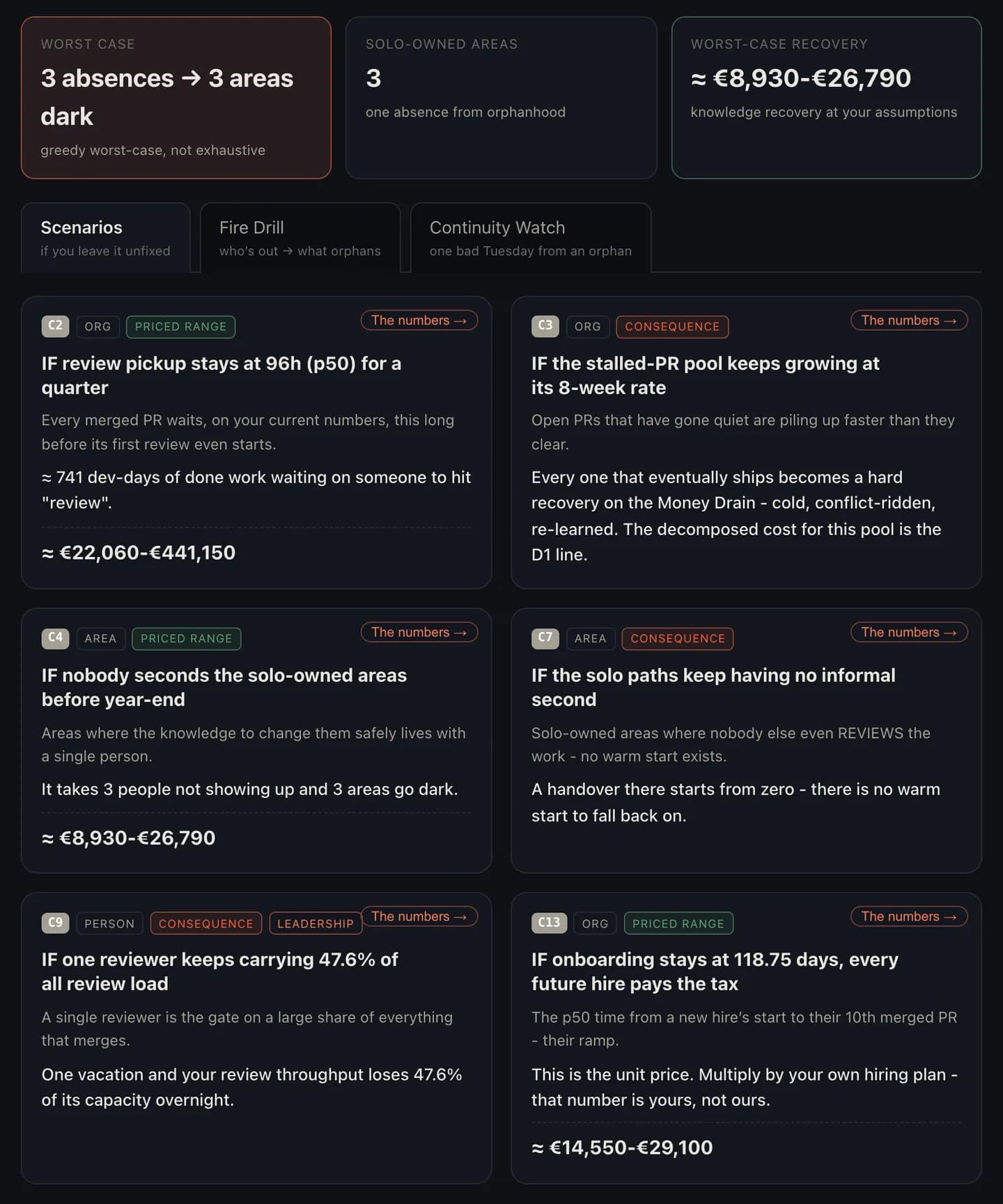
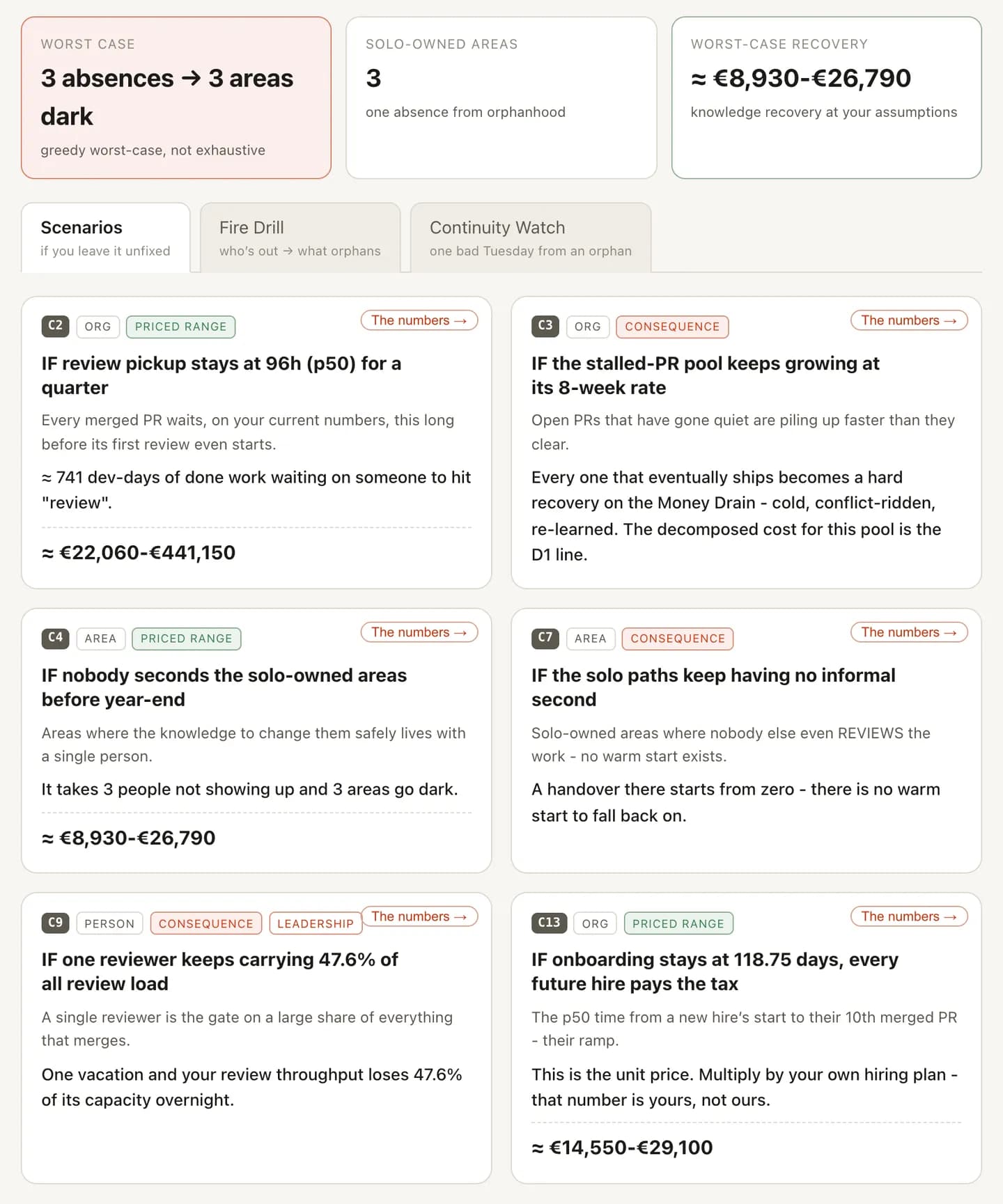
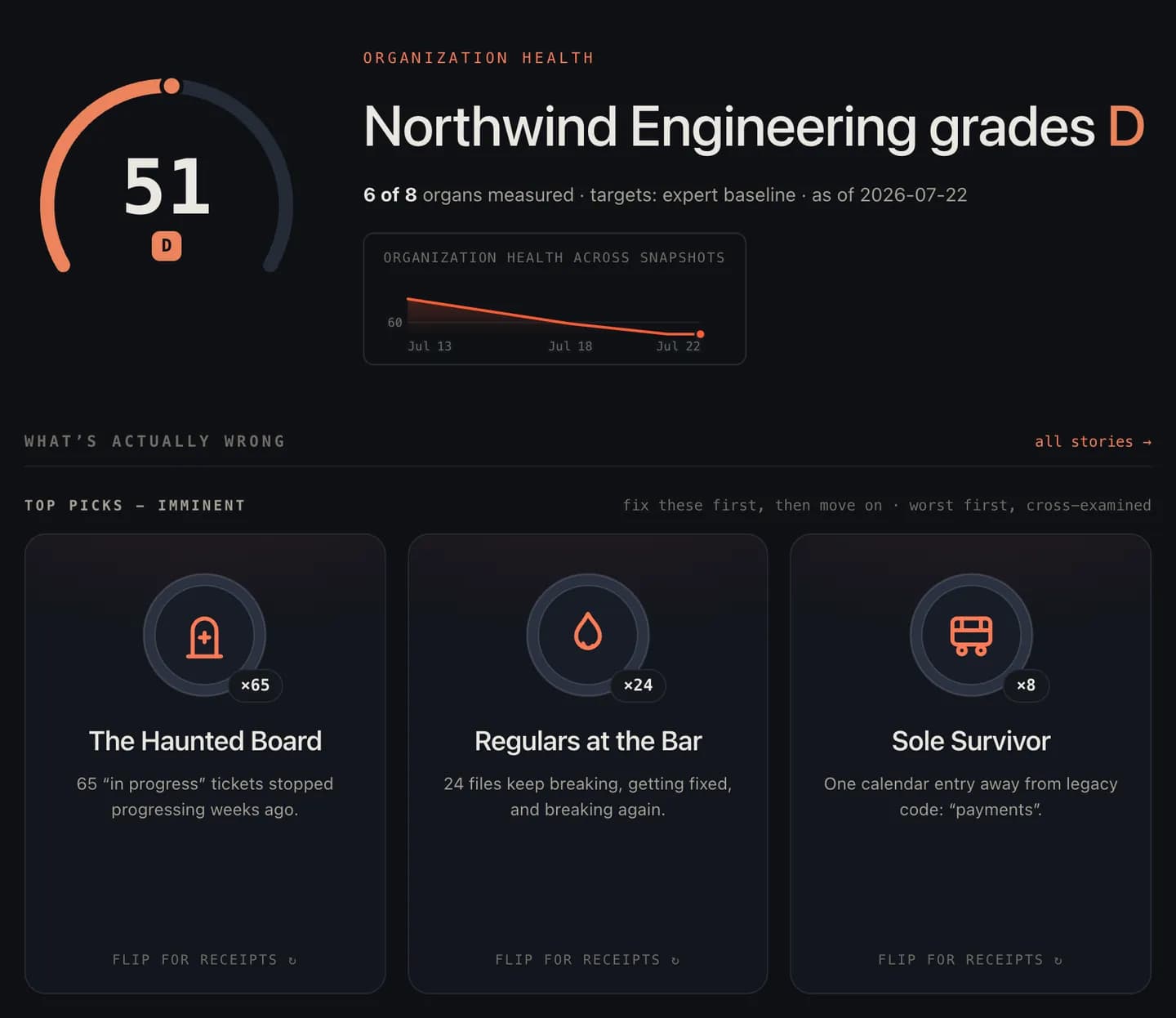
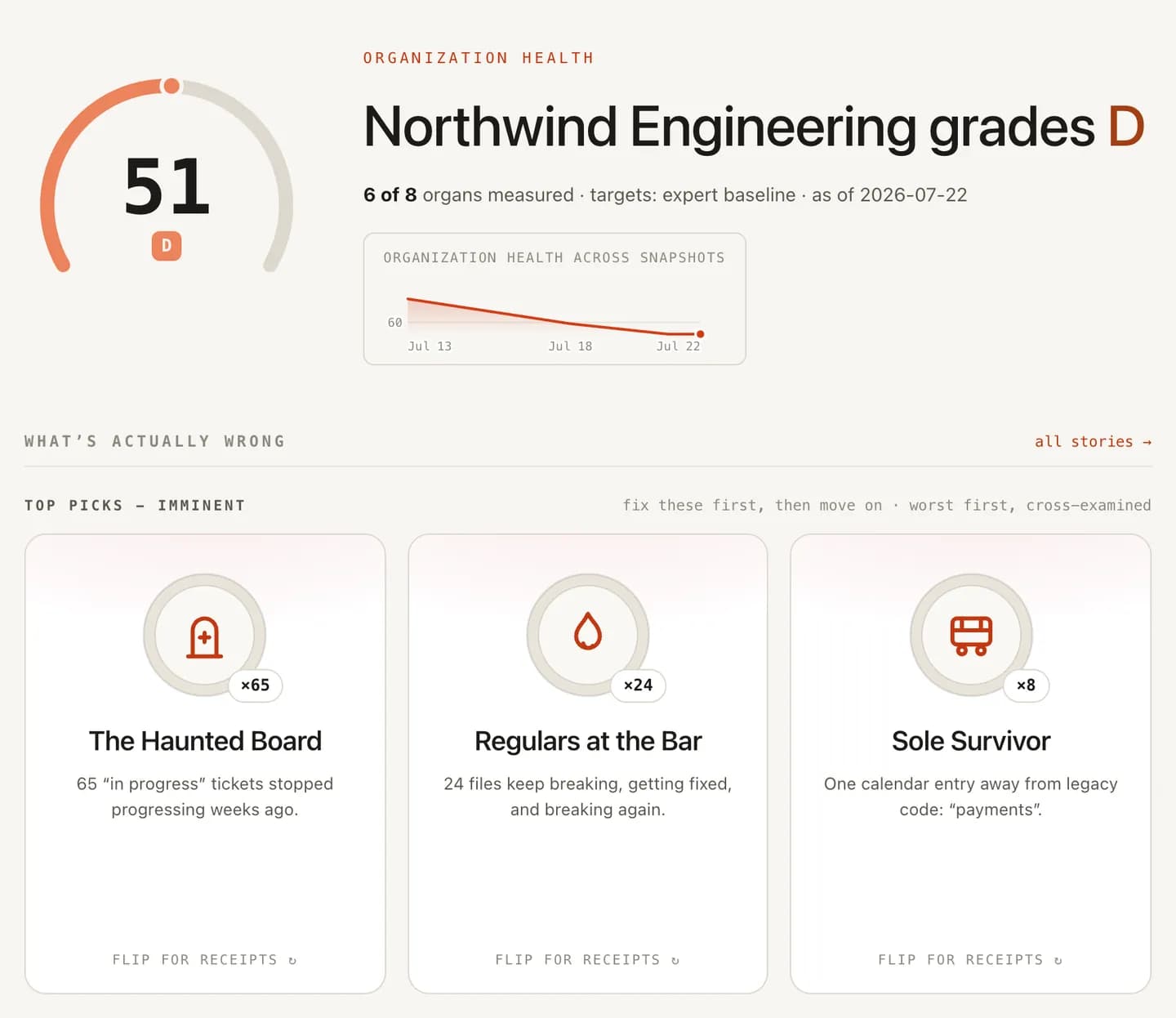
Busfactor runs the buyer's analysis continuously: authorship-weighted, review-aware ownership per area, the bus-factor-1 flags, and the departure simulation that turns an abstract score into a sentence a board understands - it takes two people not showing up, and eight areas become orphans - each finding linked to the commits and reviews behind it. The honest limit is the same one the analyst has: git shows authorship and review, not what's in heads or on pagers. The map tells you where to have the conversation; it doesn't replace it.
The door
The data-room version of this analysis costs you negotiating leverage. The this-week version costs ninety minutes and a repo connection. Compute your own number, fix the worst two areas, write the memo. Then walk into diligence as the person who hands over the report instead of the one who receives it.
Frequently asked
Do acquirers really check bus factor in due diligence?
Yes. An acquirer is buying the ability to keep changing the product, and if that ability lives in one or two heads, the asset walks out of the building on two legs. Diligence teams get repository access, and the method for estimating truck factor from git history has been published research since 2016. Assume any competent analyst will run some version of it.
What is key person risk in an acquisition?
It's the risk that the product's maintainability depends on specific individuals rather than on the organization: single-owner systems, one reviewer who gates everything, deploy and vendor knowledge that lives in one head. In a deal it turns into a named finding that shapes terms.
How does key person risk affect deal terms?
Qualitatively: what a buyer can't de-risk, they price. Concentration findings usually surface as retention packages for named individuals, holdbacks and conditions tied to their staying, or a harder negotiating posture overall. The precise impact varies by deal; the reliable part is that a discovered, unmitigated concentration reads worse than a known, mitigated one.
How do I reduce key person risk before a sale or fundraise?
Run the buyer's analysis on yourself first: compute ownership concentration from your git history, inventory the areas that orphan if one person leaves, then spread the worst two via review rotation and deliberate ticket routing. Do it months out: knowledge transfer has a floor on how fast it can go, and a notice period is the most expensive place to discover that.