Documentation Debt: Why Your Team Can't Find Anything
Documentation debt is why most developers lose 30-plus minutes a day searching for answers. How it accrues, what it costs, and how to pay it down for real.
Source: Stack Overflow 20242 receipts in this article ↓
TL;DR: Documentation debt is the gap between what your team needs to know and what's actually written down, findable, and true. In Stack Overflow's 2024 survey, 61% of professional developers reported spending more than 30 minutes a day searching for answers. The debt accrues one reasonable shortcut at a time, charges interest in search time and single-owner risk, and gets paid down by putting docs where the churn is, starting with the areas one person owns.
Every team has the moment. Someone asks in Slack where the staging credentials rotation is documented. Three people reply with three different links. Two are dead. The third describes the process from two re-orgs ago. The actual answer arrives twenty minutes later from the one person who just knows - and everyone silently updates their internal note: don't search, ask Priya.
That note is the sound of documentation debt compounding. And like most debt, nobody took it out on purpose.
What is documentation debt?
Documentation debt is the accumulating gap between what your team needs to know to work safely and quickly, and what is actually written down, findable, and current. All three conditions matter. Docs that don't exist, docs that exist but nobody can locate, and docs that are confidently wrong are three flavors of the same debt. The third is the most expensive, because a stale doc actively misleads.
The "debt" framing is precise. Like technical debt, it's taken on in small, individually defensible increments: we'll document it after the deadline, the code is self-explanatory, everyone already knows this. Each shortcut is fine. The compound position is a codebase where the map exists only in heads, which is how documentation debt matures into bus factor risk: undocumented + single-owned is the exact recipe for the areas that go dark when one person leaves.
Developers can feel the weight even when nobody's measured it. In the 2024 Stack Overflow Developer Survey, technical debt was the top frustration, named by 63% of respondents, and the undocumented kind is its most invisible form.
What documentation debt actually costs
The headline number: in that same Stack Overflow 2024 survey, 61% of professional developers reported spending more than 30 minutes a day searching for answers or solutions. Take the survey's own floor - 30 minutes - and that's over 2.5 hours per affected developer per week spent hunting instead of building. Across a 20-person team where the survey's ratio holds, you're staffing more than a full-time engineer's worth of hours on looking for things.
And search time is the cheap part. The expensive parts:
- Interrupt load on the experts. Every question that docs can't answer becomes a Slack ping to whoever knows. The people being interrupted most are precisely your most knowledge-concentrated engineers - the same 45.2% silo problem, wearing a different hat.
- Onboarding drag. New engineers reconstruct the map by archaeology: reading code, guessing intent, asking. Months to productivity that better maps would cut down.
- Single points of failure hardening in place. When the answer lives only in someone's head, that someone becomes load-bearing. Truck-factor research by Avelino et al. found 34% of 133 popular GitHub projects at a truck factor of 1. An undocumented area is a single point of failure with no paper trail to recover from.
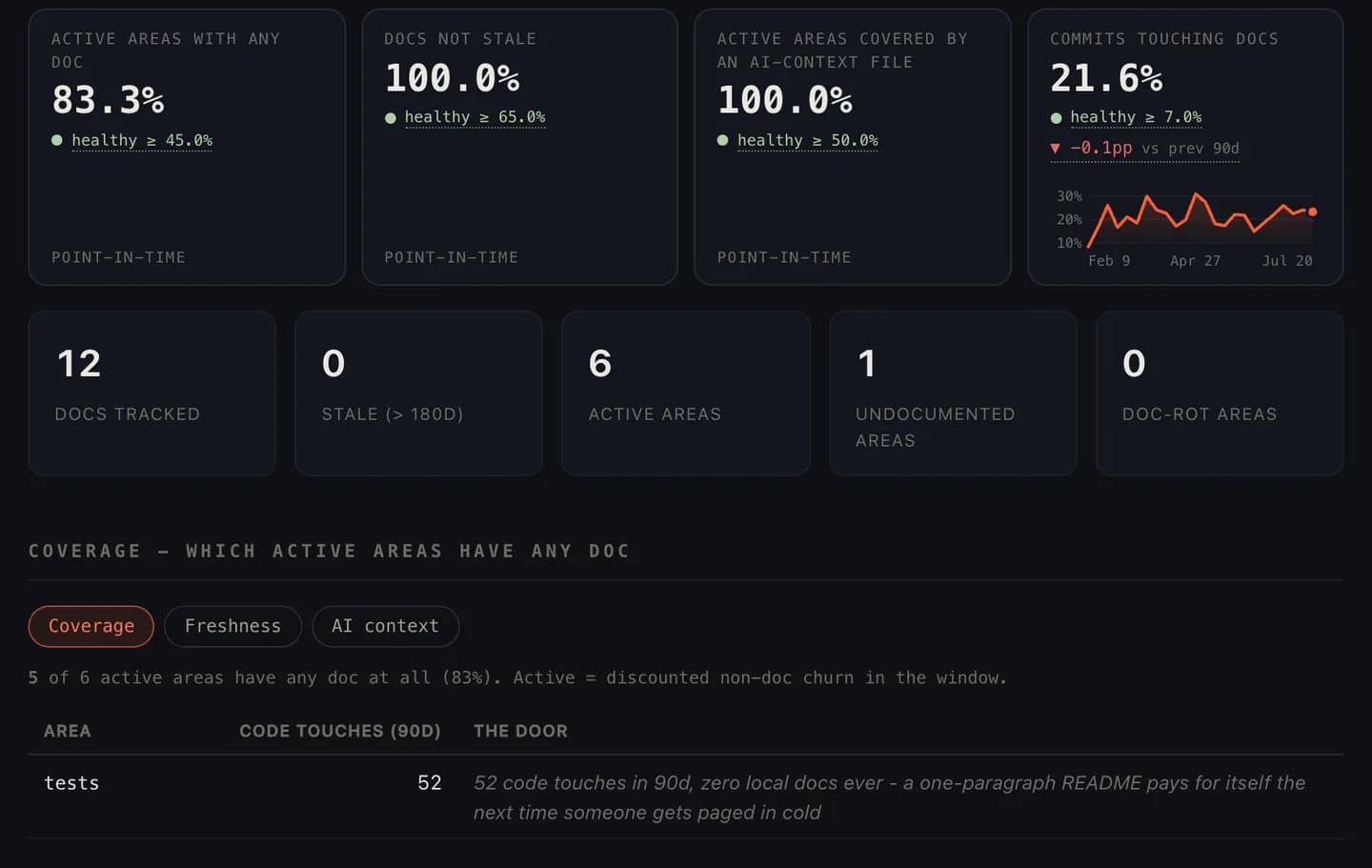
How the debt accrues
Structurally. Nobody skips docs out of laziness; they decay because of where they live and when they're written:
- Distance from the code. The wiki changes when someone remembers it exists; the code changes on every merge. Two artifacts on different update rhythms will diverge. The only question is how confidently the stale one lies.
- Written once, at the wrong time. Most docs are written at launch, when everything is obvious, and never revisited when the hard-won operational lessons arrive.
- Nobody owns them. Code has reviewers and owners; docs usually have neither. Whatever your code ownership model, if docs sit outside it, they rot outside it.
- The graveyard effect. Once enough pages are stale, developers rationally stop trusting all of them, then stop updating them, because why maintain what nobody reads? The wiki becomes write-only. That's the death spiral, and more wiki won't cure it.
How do you pay down documentation debt?
Skip the documentation sprint, and skip the decree that everything shall be documented. Documenting everything equally is how you get the graveyard. Pay down debt like an engineer: highest-interest first.
- Target the intersection of critical and single-owned. Runbooks and architecture notes for the areas where the business stops if one person is out. Your knowledge-silo map is literally the prioritized backlog: hot, critical, one-name areas first; cold corners never.
- Put docs in the repo, next to the code. A README in the directory it describes, an architecture note beside the module, reviewed in the same PR that changes behavior. Docs that travel with the code share its update rhythm, which is the structural fix for staleness.
- Document the why, not the what. The code already says what it does. What git can't reconstruct is why the retry is 7 seconds, why the obvious refactor was rejected, what invariant the weird check protects. Short decision records outlive any prose manual.
- Make docs a transfer channel. Writing the runbook while rotating a second person into the area does both jobs at once - the doc gets battle-tested by a real novice, and the novice earns context. That pairing of artifact and apprenticeship is the core of knowledge transfer done right.
- Delete aggressively. A stale page found is worse than a page missing. Pruning counts as maintenance.
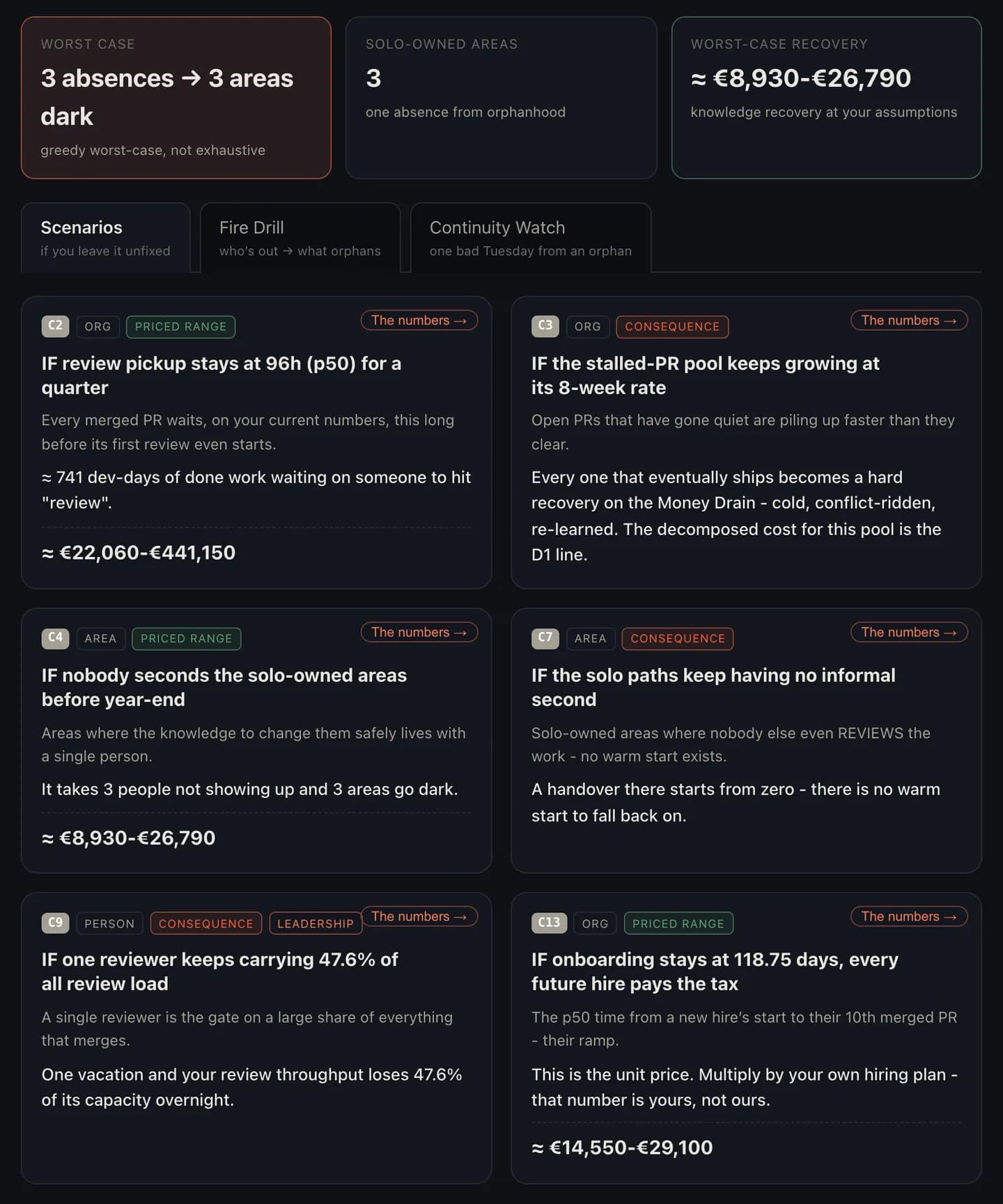
How to tell it's working
Watch the questions. Forget page count; the honest KPI is whether the same questions keep routing to the same people. If the Slack pings to your experts drop and the search-then-ask loop shortens, the debt is shrinking. If the wiki grew by 200 pages and Priya's DMs didn't get quieter, you built a bigger graveyard.
Documentation debt is the rare org problem that's boring to fix and immediately felt: every runbook placed where the churn is buys back search minutes for the whole team and takes one brick out of a future bus-factor incident. Start with your single worst critical area. Write the runbook this sprint. Then let the next resignation be a going-away party instead of an incident review.
Frequently asked
What is documentation debt?
The gap between what your team needs to know to work safely and what is actually written down, findable, and current. Like technical debt, it accrues from reasonable shortcuts (shipping without updating the README) and charges interest as search time, repeated questions, and onboarding drag.
How much time do developers lose to missing documentation?
In the 2024 Stack Overflow Developer Survey, 61% of professional developers reported spending more than 30 minutes a day searching for answers or solutions. At the survey's own floor, that's over 2.5 hours per affected developer per week spent hunting instead of building.
Why does documentation go stale so fast?
Because docs usually live far from the code they describe and change on a different rhythm. Code changes on every merge; a wiki page changes when someone remembers it exists. The fix is structural: put docs in the repo, next to the code, reviewed in the same PRs that change behavior.
What should engineering teams document first?
The intersection of critical and single-owned: runbooks and architecture notes for areas where one person holds the context. Then the why: decisions, constraints, and the non-obvious invariants git history can't reconstruct. Documenting everything equally is how wikis become graveyards.